

Why Electrical Data Cabling in Virginia Demands the Right Contractor
Electrical data cabling in Virginia is the low-voltage wiring infrastructure that keeps your business connected — think Ethernet, fiber optic, and voice cabling that runs through your walls, ceilings, and between buildings.
Quick answer for property managers looking for data cabling services in Virginia:
| What You Need | What to Look For |
|---|---|
| Cable types | Cat6, Cat6A, or fiber optic depending on speed and distance needs |
| Standards compliance | ANSI/TIA-568, NEC, and Virginia USBC |
| Contractor credentials | BICSI-certified technicians, not just a general electrician |
| Testing and documentation | Fluke DSX-8000 or similar certified test reports |
| Warranty | Up to 25-year manufacturer-backed warranty on qualifying installs |
If your buildings rely on VoIP phones, security cameras, wireless access points, or networked computers, your data cabling is the foundation everything runs on. A weak or non-compliant installation creates slow networks, failed inspections, and costly re-work.
The challenge for most commercial property managers isn’t understanding what data cabling is — it’s finding a contractor who installs it correctly, to code, and on schedule across multiple sites.
At Elliott Electric, we bring years of experience delivering commercial electrical data cabling solutions across Virginia, including our primary service areas in South Boston and Danville. We handle the complexity so your buildings stay connected and compliant.
Understanding Electrical Data Cabling Virginia: Low-Voltage vs. High-Voltage
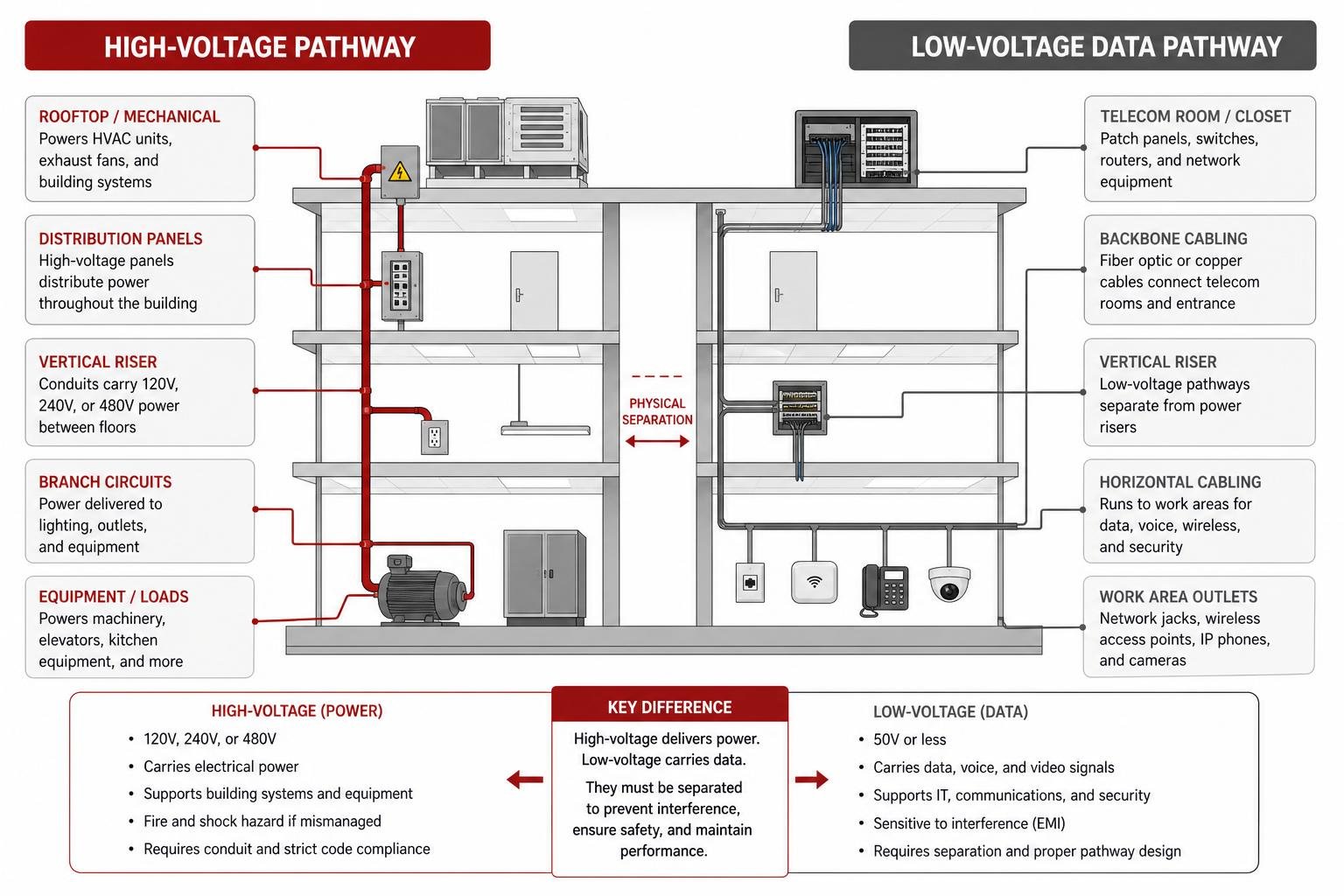
To understand how to keep your commercial property safe and connected, we must first clear up a common point of confusion: the difference between high-voltage electrical wiring and low-voltage electrical data cabling.
While they both live behind your drywall and run through your ceiling grids, they serve entirely different purposes and operate under different physical and regulatory rules.
- High-Voltage Electrical Wiring: This is the muscle of your building. Operating typically at 120V, 240V, or 480V in commercial settings, high-voltage wiring delivers raw power to your lighting, HVAC systems, machinery, and wall outlets. It is designed to carry electrical currents that can power heavy machinery—and, if mismanaged, present serious fire and shock hazards.
- Low-Voltage Data Cabling: Think of this as the nervous system of your business. Typically operating at 50 volts or less, low-voltage cabling includes ethernet (Cat6, Cat6A), fiber optics, coaxial cables, and telephone lines. Instead of raw electrical power, these cables carry digital data packets, voice signals, and video feeds.
In a modern commercial facility, these two systems must work in perfect harmony. For example, your high-voltage system powers your server racks, while your low-voltage system connects those servers to the outside world.
However, running them too close together is a recipe for disaster. High-voltage lines generate electromagnetic fields. If low-voltage data cables are run parallel to high-voltage power lines without proper separation, those electromagnetic fields leak into the data lines. This phenomenon, known as electromagnetic interference (EMI), results in dropped data packets, slow network speeds, and mysterious connection dropouts that will drive your IT department crazy.
Proper system integration requires careful routing, physical separation, and specialized shielding. When we design and execute commercial electrical projects in Virginia, we ensure that low-voltage data pathways are kept at safe distances from high-voltage conduits, preserving both network performance and code compliance.
Types of Structured Cabling and Installation Environments
No two commercial buildings are identical, which is why a “one-size-fits-all” approach to cabling never works. Depending on your industry, building layout, and speed requirements, you will need a customized mix of copper and fiber optic cabling.
The table below breaks down the primary options used in modern commercial installations:
| Cable Type | Maximum Speed | Maximum Distance | Best Used For |
|---|---|---|---|
| Cat5e | 1 Gbps | 100 meters | Legacy systems, basic VoIP phones, budget installations |
| Cat6 | 10 Gbps | 55 meters (1 Gbps up to 100m) | Standard office workstations, local printers, basic WAPs |
| Cat6A | 10 Gbps | 100 meters | High-performance offices, server rooms, PoE+ devices |
| Multimode Fiber | Up to 100 Gbps | 2 kilometers (depending on grade) | Backbone cabling, connecting local telecom closets (IDFs) |
| Single-Mode Fiber | Virtually Unlimited | Up to 100 kilometers | Campus connections, high-speed data centers, long-distance runs |
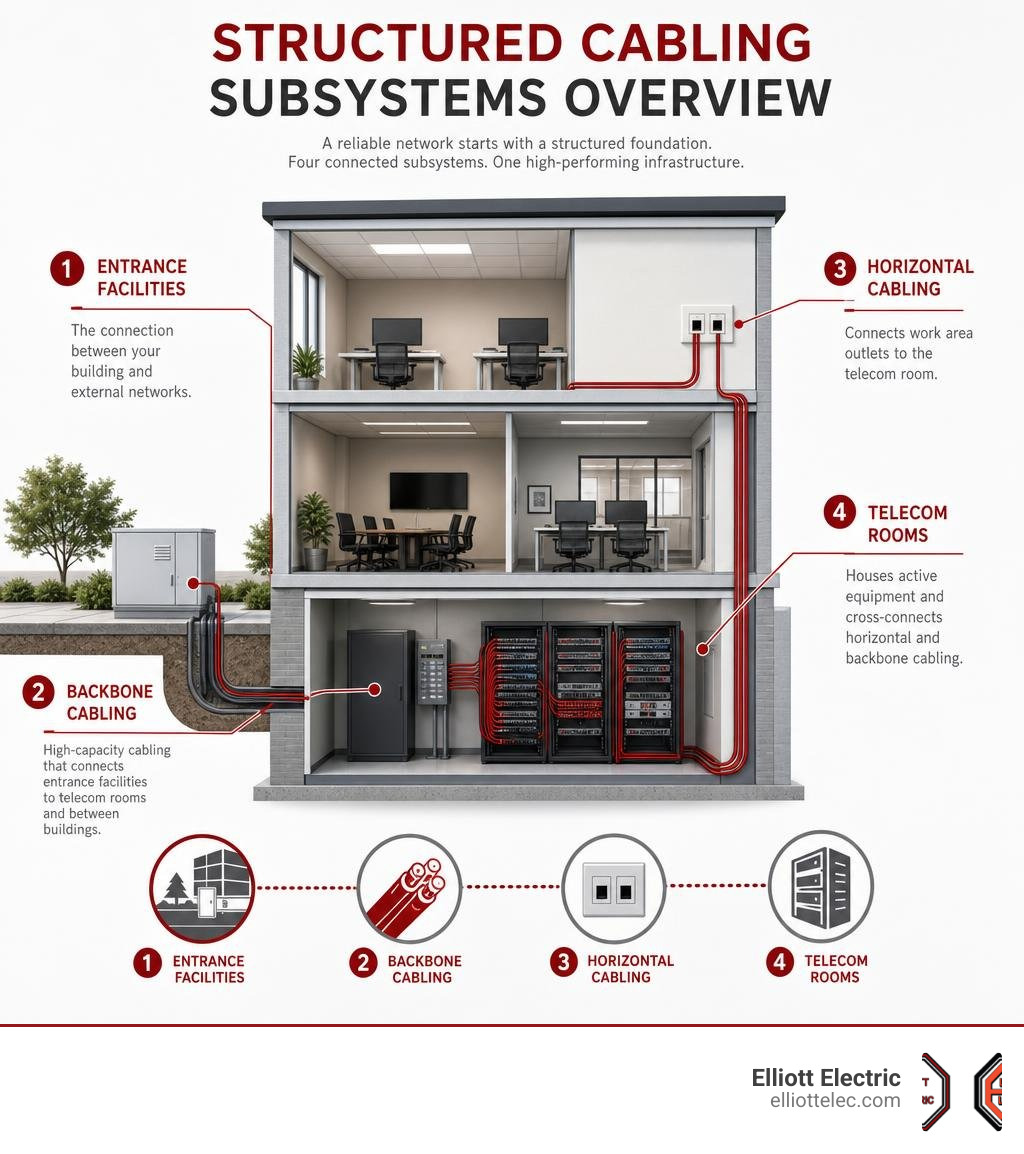
When building out your infrastructure, it is also important to understand the different physical environments where these cables are placed. Standard structured cabling is divided into three primary zones:
- Inside Plant (ISP): This refers to all cabling running inside your building’s walls, ceilings, and underfloor spaces. It connects individual workstations to local telecommunications closets.
- Backbone Cabling (Risers): This is the cabling that connects your main distribution frame (MDF) to intermediate distribution frames (IDFs) on different floors or sections of your building. It acts as the central highway for all data flowing through your facility.
- Outside Plant (OSP): This includes all cabling that runs outside, whether overhead on poles or underground via trenching and directional boring. OSP cabling must be heavily armored and gel-filled or water-blocked to withstand moisture, temperature swings, and physical wear.
To learn more about the broader concepts of structured infrastructure, you can review resources like the guide on Structured Cabling – Virginia TIP or browse through specialized suppliers like Network Supply to see the raw hardware that makes these systems possible.
Copper Solutions: Cat5e, Cat6, and Cat6A
Copper twisted-pair cabling remains the workhorse of the modern office. While Cat5e is still found in older installations, modern commercial standards in 2026 heavily favor Cat6 and Cat6A.
The primary driver behind the shift to Cat6A is bandwidth and the rise of Power over Ethernet (PoE). Devices like high-definition security cameras, smart lighting, and high-speed wireless access points (WAPs) do not just need data; they also draw their electrical power directly from the ethernet cable.
Cat6A features thicker copper conductors and tighter twisting, which helps dissipate the heat generated by high-power PoE applications. Additionally, Cat6A supports 10 Gbps speeds across its entire 100-meter maximum length, whereas standard Cat6 drops down to 1 Gbps once you exceed 55 meters. If you are planning a network designed to last for the next decade, Cat6A is the baseline copper standard you should consider.
Fiber Optic Cabling: Single Mode vs. Multimode
When your data needs to travel further than 100 meters, or when you need massive bandwidth between server rooms, copper is no longer an option. It is time to upgrade to fiber optics.
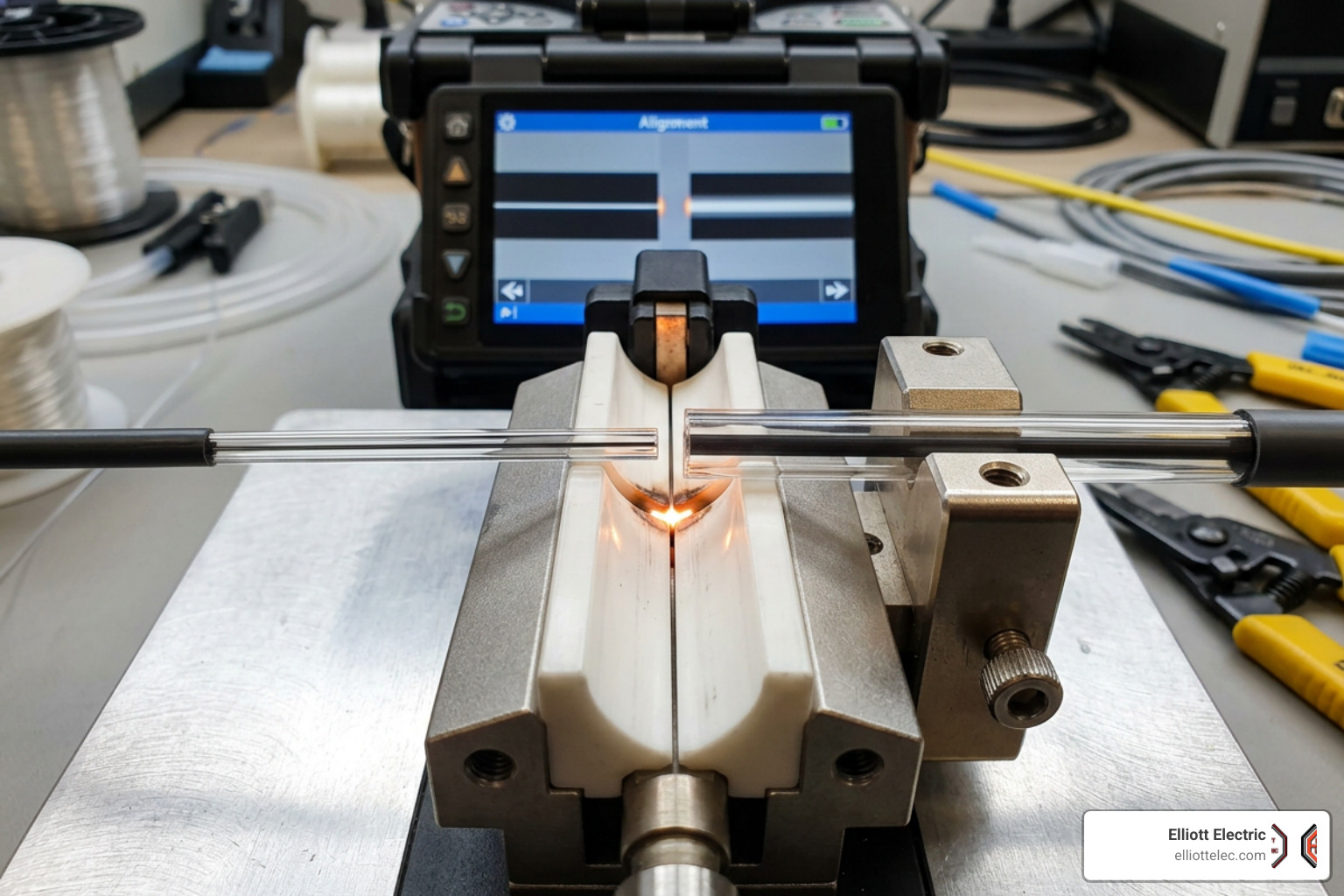
Fiber optic cables transmit data as pulses of light through thin strands of glass. This makes them entirely immune to electromagnetic interference (EMI) and allows them to carry data over incredible distances.
- Single-Mode Fiber (OS2): Featuring a tiny core of about 8 to 10 microns, single-mode fiber uses a precise laser light source. Because the light travels in a single, straight path, there is almost no signal degradation. This allows single-mode fiber to carry data at speeds up to 100 Gbps over distances spanning up to 100 kilometers. It is the gold standard for connecting separate buildings on a campus or linking remote industrial facilities.
- Multimode Fiber (OM3/OM4): With a larger core of 50 to 62.5 microns, multimode fiber allows multiple paths of light (modes) to travel down the cable simultaneously. Because it uses cheaper LED or VCSEL light sources, the optical transceivers are much more affordable than single-mode equivalents. However, the multiple light paths cause signal dispersion over long distances, limiting multimode fiber to about 2 kilometers. It is ideal for vertical risers inside a single building or connecting server racks in a data center.
For complex environments, companies often rely on specialized installers. You can read more about enterprise-scale fiber deployments at Telecommunication Data Cabling | Fiber Optic Cable Cat5 Cat6 or explore regional services like those detailed at Structured Cabling | Fiber Optic & Data Cabling Services in Virginia Beach.
Industry Standards, Codes, and Compliance Requirements
Installing electrical data cabling in Virginia is not just about pulling wire from point A to point B. If your installer does not follow strict industry standards and local building codes, your network could suffer from performance issues, and your business could face severe code violation penalties.
The primary regulatory and standard-setting bodies include:
- The National Electrical Code (NEC): Updated every three years, the NEC dictates the safety standards for all electrical and low-voltage wiring. It focuses heavily on fire safety, grounding, and preventing high-voltage hazards from crossing into low-voltage systems.
- ANSI/TIA Standards: The American National Standards Institute and Telecommunications Industry Association define the performance, design, and installation criteria for structured cabling systems.
- BICSI (Building Industry Consulting Service International): This global association provides credentials and guidelines for cabling design and installation best practices.
One of the most critical code requirements for indoor installations is the use of plenum-rated cabling. The plenum space is the open area above a drop ceiling or below a raised floor used for heating and air conditioning circulation. If a fire breaks out, standard PVC-jacketed cables burn quickly and release highly toxic, black smoke that can travel through the HVAC system to the rest of the building.
Plenum-rated cables are jacketed with special fire-resistant plastics (like Teflon) that emit very little smoke and self-extinguish. Failing to use plenum-rated cables in air-handling spaces is one of the most common reasons commercial properties fail their electrical inspections in Virginia.
When we manage projects, such as our commercial work in South Boston and Danville, we ensure that every cable run meets these safety standards. For instance, you can learn more about our local standards-compliant electrical and low-voltage work on our services page for Danville.
Key Standards for Electrical Data Cabling Virginia Projects
To ensure your network is reliable and easy to maintain, your data cabling contractor must adhere to the following core ANSI/TIA standards:
- ANSI/TIA-568: This is the master standard for commercial building telecommunications cabling. It dictates how copper and fiber cables must be terminated, maximum cable lengths, and minimum performance testing criteria.
- ANSI/TIA-569: This standard governs the pathways and spaces used for telecom equipment. It outlines how cable trays, conduits, and server rooms must be designed to support the weight and bend radius of data cables.
- ANSI/TIA-606: The standard for administration and labeling. It requires every single cable, patch panel port, and wall outlet to be clearly and systematically labeled. If you have ever looked at a messy server closet that looks like a “cable monster,” you are looking at a system that ignored TIA-606.
- ANSI/TIA-607: This standard covers grounding and bonding. Proper grounding protects your expensive networking hardware from electrical surges and static build-up.
Local Virginia Building Codes and Permitting
In Virginia, all construction and electrical work must comply with the Virginia Uniform Statewide Building Code (USBC). Local jurisdictions—whether you are operating in South Hill, Chase City, Brookneal, Clarksville, or Halifax County—have specific permitting and inspection processes.
Low-voltage installations often require permits just like high-voltage electrical work. If you are setting up a new office, upgrading an old manufacturing facility, or installing advanced systems like satellite receivers, local inspectors will check for:
- Proper firestopping where cables pass through fire-rated walls.
- Appropriate cable support (cables must be suspended using J-hooks or cable trays, never resting directly on ceiling tiles or grid wires).
- Correct grounding of data racks.
For regional local examples, you can look at resources like Electrician Services in Halifax County, VA | Got Electric, Top 10 Best Electricians in South Hill, VA | Angi, or Top 10 Best Electricians in Chase City, VA | Angi.
Additionally, if you are coordinating specialized setups like Starlink in rural sectors, you can check out Starlink Installation Services in Clarksville, VA or Starlink Installation in Brookneal, VA Starlink Installers to see how local physical terrain and structural requirements shape low-voltage installations.
Choosing the Right Contractor, Testing, and Long-Term ROI
It is tempting to think that any general electrician can pull data cables. After all, a wire is a wire, right?
Unfortunately, this is a costly misconception. While general electricians are experts at handling high-voltage power distribution, structured data cabling requires a completely different set of skills, tools, and testing methodologies.
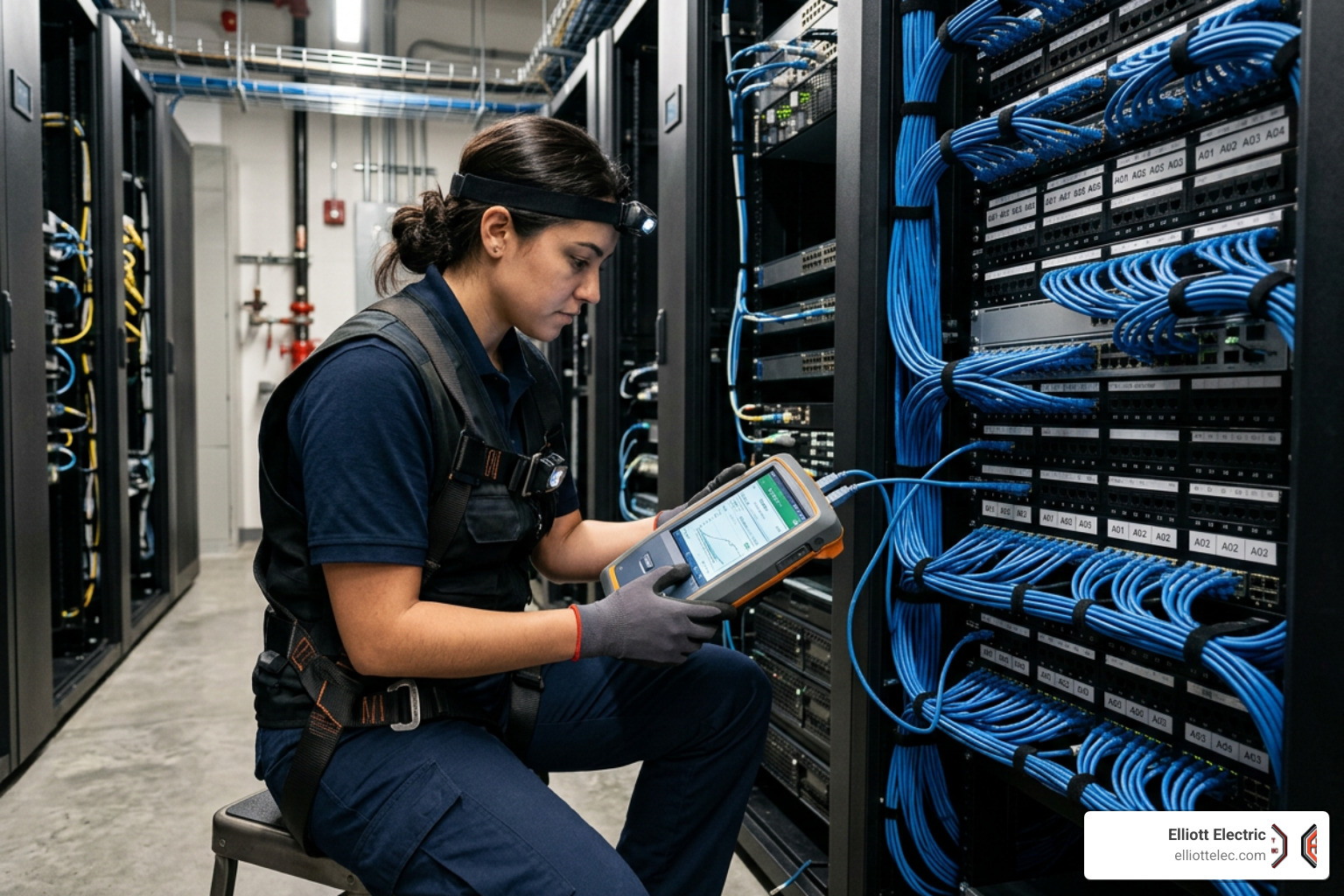
Data cables are delicate. Pulling them with too much tension, bending them too sharply, or untwisting the pairs too much at the termination point can ruin their high-speed capabilities. A general electrician might check a cable with a simple continuity tester to see if the copper wires are connected. But a continuity tester cannot tell you if the cable will suffer from crosstalk, signal attenuation, or return loss when running at 10 Gbps.
To guarantee performance, you need a specialized low-voltage contractor who uses advanced certification equipment. At Elliott Electric, our technicians utilize industry-leading tools like the Fluke DSX-8000 CableAnalyzer and the Fluke OptiFiber Pro OTDR.
These devices do not just check if the wires are connected; they run a battery of high-frequency tests to certify that every single run meets strict ANSI/TIA standards. Once completed, we provide our clients with detailed, printed PDF test reports for every single cable drop. This is your insurance policy, proving that your physical network is flawless.
Investing in a professional, certified installation also secures your long-term return on investment (ROI). Properly installed systems are eligible for 25-year manufacturer-backed warranties on both materials and labor. If a certified cable fails five or ten years down the road, the manufacturer covers the cost of replacement. Furthermore, an organized, labeled structured cabling system makes troubleshooting a breeze, reducing network downtime from hours to minutes.
To explore how we serve businesses with both power and data needs in South Boston and surrounding areas, you can visit our South Boston services page.
Why Certified Electrical Data Cabling Virginia Specialists Matter
Working with a certified specialist ensures your infrastructure is built to scale. As your business grows and introduces new technologies—like IoT devices, smart building controls, and advanced AV systems—a certified Cat6A or fiber optic plant will handle the increased bandwidth without needing a costly “rip-and-replace” upgrade.
For businesses looking for specialized low-voltage and electrical integrations in other regions, you can read about regional capabilities at Structured Cabling and Wireless | CAT 6, Fiber Optic & Line-of-Sight or Data Wiring Installation | Newport News, VA – Fresh Start Electrical to see how professional contractors structure their low-voltage offerings.
Frequently Asked Questions about Virginia Data Cabling
What is the difference between Cat6 and Cat6A cabling?
The primary differences lie in bandwidth, frequency, and distance capabilities. Cat6 operates at a frequency of 250MHz and can support 10 Gbps speeds, but only up to a maximum distance of 55 meters. Beyond that, it drops back to 1 Gbps.
Cat6A operates at 500MHz and supports full 10 Gbps speeds up to its maximum length of 100 meters. Cat6A also features superior shielding, making it much better suited for high-power Power over Ethernet (PoE) devices and environments with high electromagnetic interference.
Why do ANSI/TIA standards matter for my business network?
ANSI/TIA standards ensure design consistency, interoperability, and future-proofing. When your cabling system follows these standards, you can plug in hardware from any manufacturer (Cisco, Ubiquiti, HP, etc.) and guarantee it will work perfectly.
It also ensures that any future contractor can walk into your server room, read the labeling scheme, and easily troubleshoot or expand your network without wasting hours trying to trace unlabeled wires.
How long does a commercial fiber optic installation take?
The timeline depends heavily on the project scope, building pathway accessibility, and the number of terminations. A standard indoor fiber backbone installation between two telecom closets can often be completed in a few days.
A larger campus-wide deployment requiring outdoor trenching, directional boring, or aerial runs can take several weeks. A professional installation process always starts with a detailed site assessment, followed by pathway preparation, cable pulling, fusion splicing, and a rigorous testing phase.
Conclusion
Your physical network infrastructure is the foundation of your business. Trying to save a few dollars by hiring an uncertified contractor or ignoring local building codes will inevitably lead to slow network performance, costly code violations, and system downtime.
At Elliott Electric, we bring over 75 years of experience to every commercial project we handle. Serving Danville, South Boston, and surrounding regions in Virginia, we provide fully integrated, code-compliant electrical and data cabling solutions. Backed by our professional staff and a 100% satisfaction guarantee, we ensure your business stays connected, safe, and ready for the future.
Ready to upgrade your infrastructure? Contact Elliott Electric for your commercial electrical projects in Virginia today, and let’s build a network you can rely on for decades to come.


