

Why Electrical Industrial Controls in Virginia Demand the Right Contractor
If you need electrical industrial controls in Virginia, here is a quick overview of what to look for and expect:
| What You Need | What to Look For |
|---|---|
| PLC programming & SCADA systems | Certified integrators with multi-platform experience |
| Custom control panel fabrication | UL 508A certified manufacturers |
| VFD and motor control installation | Class A licensed electrical contractors |
| Code compliance (NEC, UL) | Contractors with Virginia Class A licensure |
| 24/7 emergency service | Local providers with rapid response capability |
| Legacy system upgrades | Integrators experienced in modernization projects |
Virginia’s industrial sector runs on complex electrical control systems. From water treatment plants and steel mills to data centers and pharmaceutical facilities, these systems keep critical operations running safely and efficiently.
When something fails — or when a facility needs an upgrade — the stakes are high. Downtime costs money. Code violations create liability. And the wrong contractor can leave you with a system that’s hard to maintain or doesn’t meet Virginia’s licensing and safety requirements.
Virginia has over 150 municipal water and wastewater facilities alone that rely on advanced PLC and SCADA systems. That scale reflects just how deeply industrial controls are woven into the state’s infrastructure — and how important it is to work with a contractor who truly knows the space.
At Elliott Electric, we bring years of hands-on experience delivering commercial and industrial electrical solutions across South Boston and Danville, VA — including work on the electrical industrial controls in Virginia that power manufacturing, municipal, and commercial facilities. We are here to help you navigate every step of your next project with confidence.
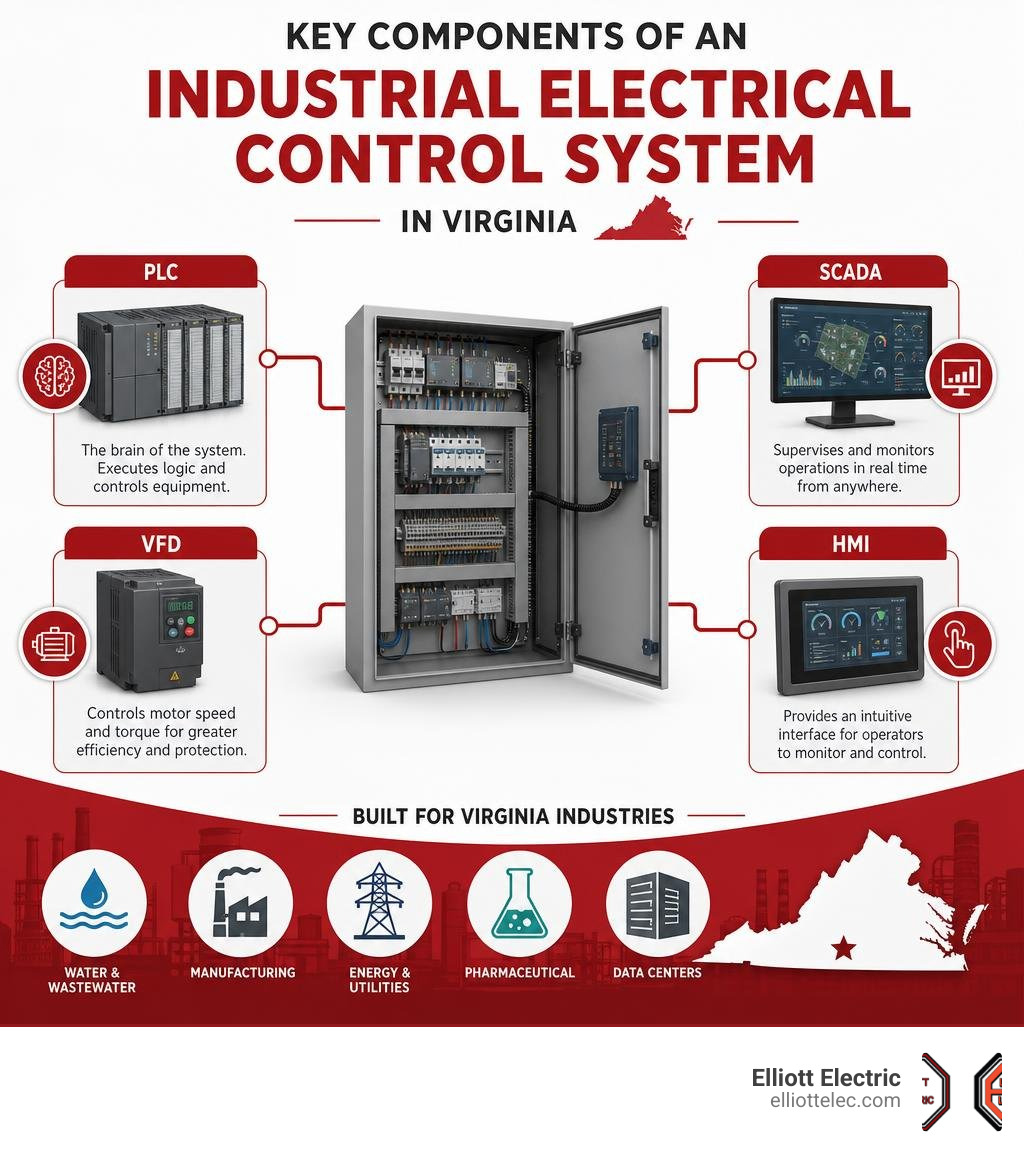
Core Industries Relying on Electrical Industrial Controls Virginia
Industrial automation is the heartbeat of modern production and utility management across the Commonwealth. In Southern Virginia—from the manufacturing hubs of Danville and South Boston to the growing industrial corridors of Altavista and Chase City—reliable electrical control systems are essential.

Water and Wastewater Treatment Controls
Municipal water systems require continuous, precise monitoring to keep public drinking water safe and manage wastewater discharge. Across Virginia, municipal facilities utilize Supervisory Control and Data Acquisition (SCADA) systems and Programmable Logic Controllers (PLCs) to manage pump stations, flow rates, and chemical treatment levels.
In public utilities like the James City Service Authority, skilled controls professionals manage complex telemetry and variable frequency drives (VFDs) to prevent system failures. For local governments and utility boards, partnering with an experienced contractor is key to upgrading aging pump controls and keeping treatment facilities online. You can learn more about how these infrastructure upgrades are executed by exploring commercial electrical projects in Virginia.
Advanced Manufacturing and Mission-Critical Facilities
From heavy industrial plants like steel rolling mills to high-tech manufacturing, continuous uptime is non-negotiable. Modern plants require highly specialized electrical and instrumentation engineering. For example, steel manufacturers such as Gerdau recruit advanced Controls Engineers to maintain complex PLC platforms (including Siemens S7, Rockwell, and GE RX3i) to ensure their rolling mills run without interruption.
In addition to heavy manufacturing, Southside Virginia is home to mission-critical data centers and advanced fiber producers that require perfect power quality and climate control. A single power dip or control error can ruin a production batch or drop a server network. Industrial electrical contractors must design robust, redundant control systems that prevent these costly failures.
Essential Services for Industrial Automation
To keep these diverse industries running, industrial control contractors provide a comprehensive suite of technical services. These services bridge the gap between heavy electrical wiring and digital computer programming.
PLC Programming and SCADA Integration
The Programmable Logic Controller (PLC) is the physical “brain” of any automated machine, while SCADA is the software “eyes and ears” that allow operators to monitor the entire plant. Experienced control technicians program these devices to automate repetitive physical tasks, translate operator requests into mechanical motion, and manage alarm reporting.
Top-tier integrators work across multiple industry-standard platforms, including:
- Rockwell Automation / Allen-Bradley (ControlLogix, CompactLogix)
- Siemens (S7-1200, S7-1500, TIA Portal)
- Schneider Electric / Modicon
- GE / Emerson (RX3i controllers)
These PLCs must communicate seamlessly over industrial networks using protocols like Profinet, Profibus, and EtherNet/IP. This data is fed directly into Human-Machine Interfaces (HMIs) and SCADA software packages such as Ignition, Aveva Wonderware, or VT SCADA, allowing operators to make real-time operational decisions.
Custom Panel Fabrication and VFDs in Electrical Industrial Controls Virginia
Every automated system requires a physical enclosure to house its sensitive electronics, circuit breakers, and motor controls. Custom control panel fabrication involves designing and building these enclosures to fit specific spatial and environmental needs.
Within these panels, Variable Frequency Drives (VFDs) and motor soft starters are installed to control the speed and torque of industrial motors. Implementing VFDs reduces energy consumption and minimizes mechanical wear and tear during motor startup.
| Control Method | Best Used For | Key Benefits |
|---|---|---|
| Variable Frequency Drive (VFD) | Centrifugal pumps, fans, conveyors, and processes requiring variable speed. | Precise speed control, massive energy savings, and reduced mechanical stress. |
| Motor Soft Starter | Heavy-duty motors that run at a constant speed but require a smooth startup. | Lowers high inrush startup current, prevents water hammer in pumps, and is highly cost-effective. |
When deploying these systems, working with local support is critical. For instance, companies in Southern Virginia often rely on experienced local electrical contractors to handle localized installations, emergency troubleshooting, and direct motor control wiring.
Compliance, Safety, and Class A Licensing in Virginia
Industrial electrical systems operate at high voltages and control powerful mechanical machinery. There is zero room for error when it comes to safety and regulatory compliance.

Navigating UL 508A and NEC Standards for Electrical Industrial Controls Virginia
To ensure safety, industrial control panels should be built and certified to UL 508A standards (and UL 698A for panels controlling equipment in hazardous or explosive locations). UL 508A certification guarantees that all components within the panel have been tested, rated, and wired to handle high-voltage loads safely.
Furthermore, all physical installations must strictly adhere to the National Electrical Code (NEC). This includes proper grounding, wire labeling, overcurrent protection, and arc-flash safety boundaries. Utilizing certified panel builders and expert installers mitigates liability and ensures your equipment passes local municipal inspections without delays.
The Value of a Class A Licensed Electrical Contractor
In Virginia, electrical contracting is strictly regulated. Working with a Class A licensed electrical contractor is vital for any industrial-scale project. A Class A license requires the highest level of insurance, financial backing, and verified field experience.
Class A contractors manage major turn-key projects from initial electrical design and permitting through physical construction and final commissioning. They also implement rigorous safety programs to protect both their technicians and your facility’s staff. For businesses operating in Southside Virginia, partnering with a trusted Class A contractor ensures that your high-voltage power distribution and control systems are built to code. For more details on localized commercial and industrial services, view our South Boston commercial electrician services.
Modernization, BAS Integration, and Future Trends
The industrial world is changing rapidly. As older control systems reach the end of their operational lifespans, Virginia businesses are modernizing their facilities to improve energy efficiency and leverage data.
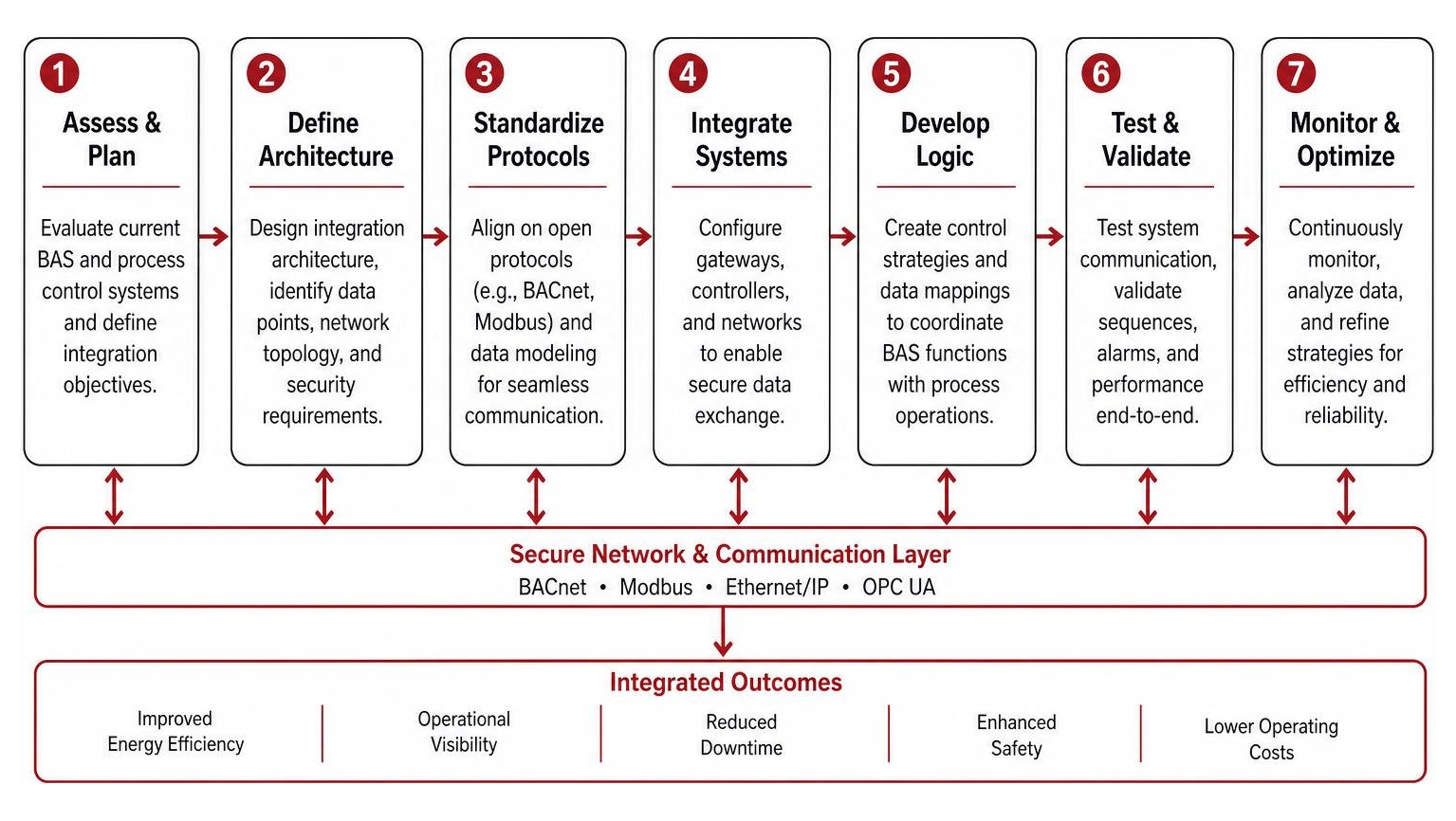
Integrating BAS with Industrial Process Controls
Historically, Building Automation Systems (BAS)—which control HVAC, lighting, and access control—were kept completely separate from industrial process controls. Today, smart facilities are integrating these systems.
By connecting BAS with process controls, plants can optimize their energy consumption. For example, if a production line goes idle, the BAS can automatically adjust the local HVAC and lighting levels to conserve energy. This integration relies on open communication protocols like BACnet and Modbus, allowing different systems to speak to one another seamlessly. Through smart programming strategies, facilities can easily save 15% to 20% on their overall energy costs.
IIoT, Cybersecurity, and Sustainable Automation
The Industrial Internet of Things (IIoT) is bringing internet connectivity directly to the factory floor. Smart sensors can now monitor equipment health and transmit data to the cloud for predictive maintenance. However, this increased connectivity introduces cybersecurity risks.
Modern SCADA systems must be designed with robust cybersecurity measures, including:
- Multi-factor authentication (MFA) for remote access.
- Network segmentation to isolate critical controls from the public internet.
- Encrypted telemetry communication.
Additionally, sustainable automation is driving the adoption of advanced valve automation and precise process control equipment. This equipment, backed by specialized industrial suppliers, ensures that chemical, gas, and water distribution systems operate with minimal waste and maximum safety.
Frequently Asked Questions about Industrial Electrical Controls
What is the difference between a PLC and a SCADA system?
A PLC (Programmable Logic Controller) is a physical hardware device installed in a control panel on the plant floor. It executes local, real-time control commands to run machinery. SCADA (Supervisory Control and Data Acquisition) is a software system, typically running on computers in a control room, that gathers data from multiple PLCs to give operators a high-level overview of the entire facility.
Why is UL 508A certification important for custom control panels?
UL 508A certification proves that a control panel meets rigorous safety standards established by Underwriters Laboratories. Local electrical inspectors in Virginia often require this certification before approving a new electrical installation. It also reduces business liability by ensuring the panel is built to prevent electrical fires and shocks.
How often should industrial control instrumentation be calibrated?
Most industrial sensors, flow meters, and temperature transmitters should be calibrated at least once a year. However, high-precision or safety-critical applications may require semi-annual or quarterly calibration. Utilizing traceable calibration services ensures your instrumentation remains accurate and compliant with quality standards.
Partner with Southern Virginia’s Electrical Experts
Implementing and maintaining electrical industrial controls in Virginia requires a contractor who blends technical expertise with a commitment to safety and compliance.
At Elliott Electric, we have spent over 75 years helping businesses in Danville, South Boston, and across Southern Virginia keep their facilities running. As a premier commercial and industrial contractor, we offer code-compliant electrical, HVAC, and plumbing solutions backed by a professional staff and our 100% satisfaction guarantee.
Whether you need a legacy control panel upgraded, a new VFD installed, or complete system integration, our team is ready to deliver. You can learn more about Elliott Electric and our long history of serving local industries.
Ready to take control of your next automation project? Partner with Elliott Electric for Your Next Industrial Control Project and let us help you build a safer, more efficient facility.


