

Is a 400 Amp Service Upgrade Right for Your Property?
A 400 amp service upgrade is one of the most significant electrical investments a property owner can make — and one of the most misunderstood.
Here’s a quick answer to the most common questions:
| Question | Short Answer |
|---|---|
| What is a 400 amp service? | It doubles your home’s capacity from 200A to handle heavy modern loads, delivering up to 96,000 watts at 240V |
| Who actually needs it? | Homes over 3,500 sq ft, multiple EV chargers, all-electric appliances, large workshops, or multiple HVAC systems |
| How much does it cost? | Typically $5,000–$20,000 depending on location, complexity, and utility requirements |
| Is it always necessary? | No — smart energy management systems (HEMS) can sometimes eliminate the need |
| Best configuration? | Dual 200A panels fed by a 320A meter base (more affordable and practical than a single 400A panel) |
Most properties in the U.S. run on either 100A or 200A service. For decades, 200A was enough. But rising power demands — think EV chargers, heat pumps, home workshops, and all-electric appliances — are pushing more properties past what a standard 200A panel can reliably handle.
The problem is that upgrading is expensive and time-consuming. It involves utility coordination, permits, new wiring, and sometimes a transformer replacement. Making the wrong call — upgrading when you don’t need to, or waiting too long when you do — costs real money.
This guide cuts through the noise and helps you make a clear, informed decision.
At Elliott Electric, we’ve helped commercial and residential clients across South Boston and Danville, VA navigate 400 amp service upgrades from load calculation through final inspection. We understand the code compliance requirements, utility coordination, and practical realities that determine whether an upgrade is truly necessary for your property.
Understanding the 400 Amp Service Upgrade: Capacity, Signs, and Necessity
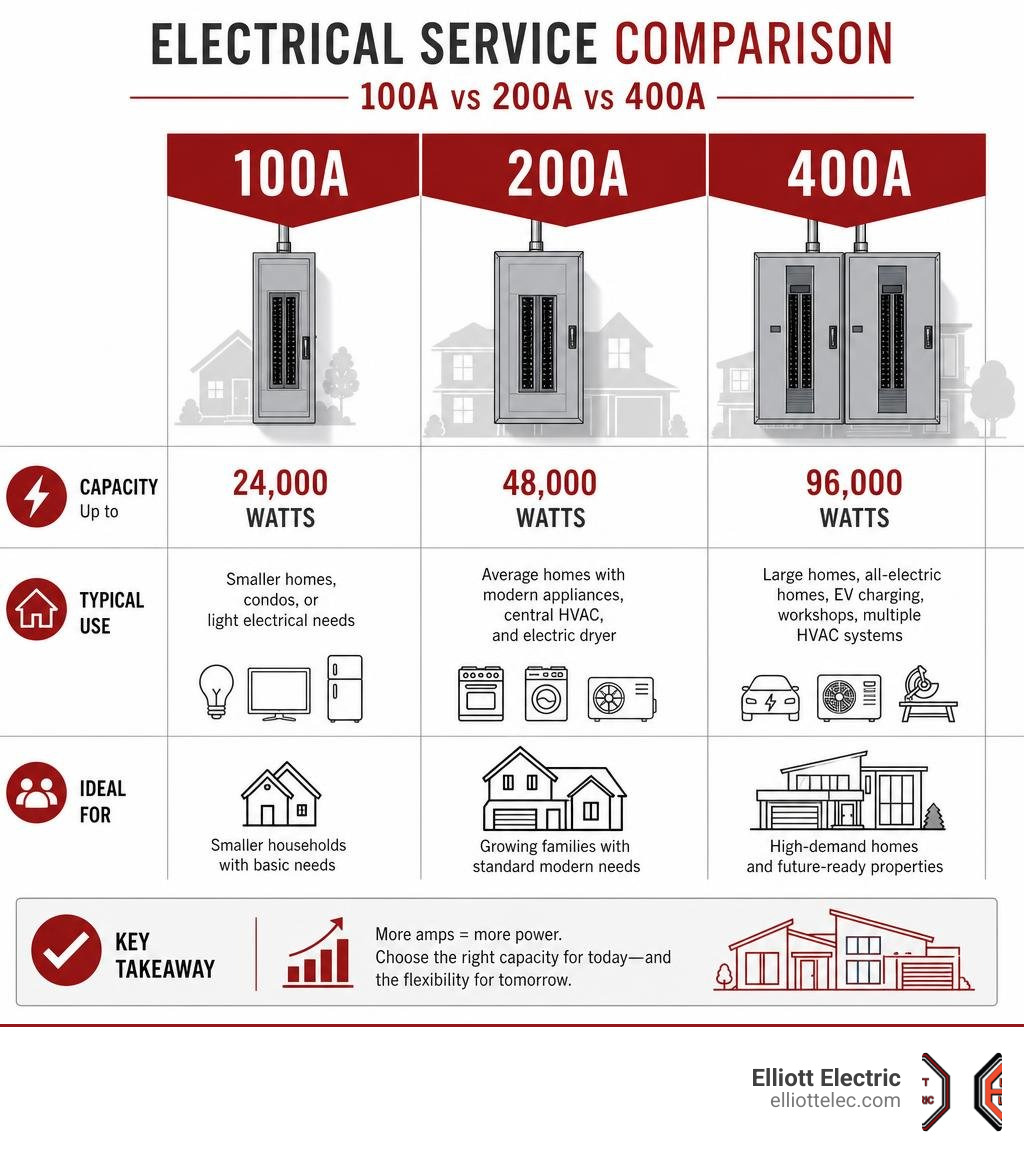
To understand why you might need a 400 amp service upgrade, it helps to look at the math. Your electrical service capacity is measured in volt-amperes, which translates directly to wattage.
A standard 100 amp service delivers up to 24,000 watts of power. A standard 200 amp service doubles that to 48,000 watts. When you upgrade to a 400 amp service, you are bringing a massive 96,000 watts of power to your property.
However, in residential and light commercial applications, a “400 amp service” is rarely a single, continuous 400-amp draw. Instead, it is typically delivered using a Class 320 meter base. This setup provides 320 amps of continuous power (the maximum load the system can handle safely for three hours or more) and up to 400 amps of peak surge capacity. For a deep dive into how these configurations function in American homes, you can read the U.S. homeowner guide to 400A panels.
This massive capacity becomes necessary when your calculated electrical load exceeds what a 200 amp panel can safely supply. Under the National Electrical Code (NEC), we use specific load calculation formulas that account for the square footage of your property, fixed appliances, heating and cooling equipment, and specialty loads. If your property is larger than 3,500 to 4,000 square feet and relies entirely on electricity for heating, hot water, cooking, and vehicle charging, a standard 200A panel will likely run dangerously close to its limit during peak usage times.
Signs Your Home Needs a 400 Amp Service Upgrade
How do you know if your current electrical system is crying out for help? There are several physical warning signs that indicate your service is overloaded:
- Frequent Breaker Trips: If turning on your microwave while the air conditioner is running sends you scrambling for the flashlight to reset a breaker, your panel is telling you it has reached its physical limit.
- Flickering Lights: When heavy-draw appliances like a heat pump, clothes dryer, or well pump kick on, your lights should not dim or flicker. If they do, it indicates a significant voltage drop caused by insufficient service capacity.
- Panel Age and Wear: Electrical panels are built to last between 25 and 40 years. If your panel is from the 1980s or 1990s, the internal bus bars and breakers may be deteriorating, reducing the system’s efficiency and safety.
- Safety Recalls: Older properties in Danville or South Boston may still have hazardous, recalled panels installed, such as Federal Pacific Electric (FPE) or Zinsco. These panels are documented fire hazards because their breakers frequently fail to trip during an overload.
- Physical Damage or Heat: If your panel door feels warm to the touch, smells like burning plastic, or shows signs of rust and corrosion, it requires immediate professional attention.
Smart HEMS: Can You Avoid a 400 Amp Service Upgrade?
Before committing to a physical service upgrade, it is worth exploring modern smart energy management alternatives. A Home Energy Management System (HEMS) paired with a smart panel (such as SPAN) can sometimes help you maximize a 200 amp panel and avoid the high cost of a full 400 amp utility upgrade.
Smart panels work by monitoring your electrical usage in real-time and actively managing your loads. They use software to schedule non-coincident loads — meaning appliances that do not need to run at the exact same time.
For example, if your HVAC system is drawing heavy power on a humid Virginia afternoon, a HEMS can temporarily pause or throttle down your Level 2 EV charger. Once the indoor temperature stabilizes and the HVAC cycle finishes, the system automatically ramps the EV charger back up. By shedding, shifting, or throttling these heavy loads, smart systems allow you to bypass the traditional 80/20 rule of panel capacity, keeping your total real-time demand safely below the 200-amp threshold.
While a HEMS is an excellent future-proofing tool, it does have limitations. If your baseline continuous load (such as multiple commercial-grade HVAC systems, a heated pool, and a large home workshop running simultaneously) physically exceeds 200 amps, no amount of smart software can safely bypass the need for a physical upgrade.
Comparing Configurations: Single 400A Panel vs. Dual 200A Panels
If a load calculation confirms that you indeed need a 400 amp service, the next step is deciding how to configure the physical hardware. You have two primary options: installing a single, massive 400-amp main breaker panel, or installing a Class 320 meter base that splits the service into dual 200-amp panels.
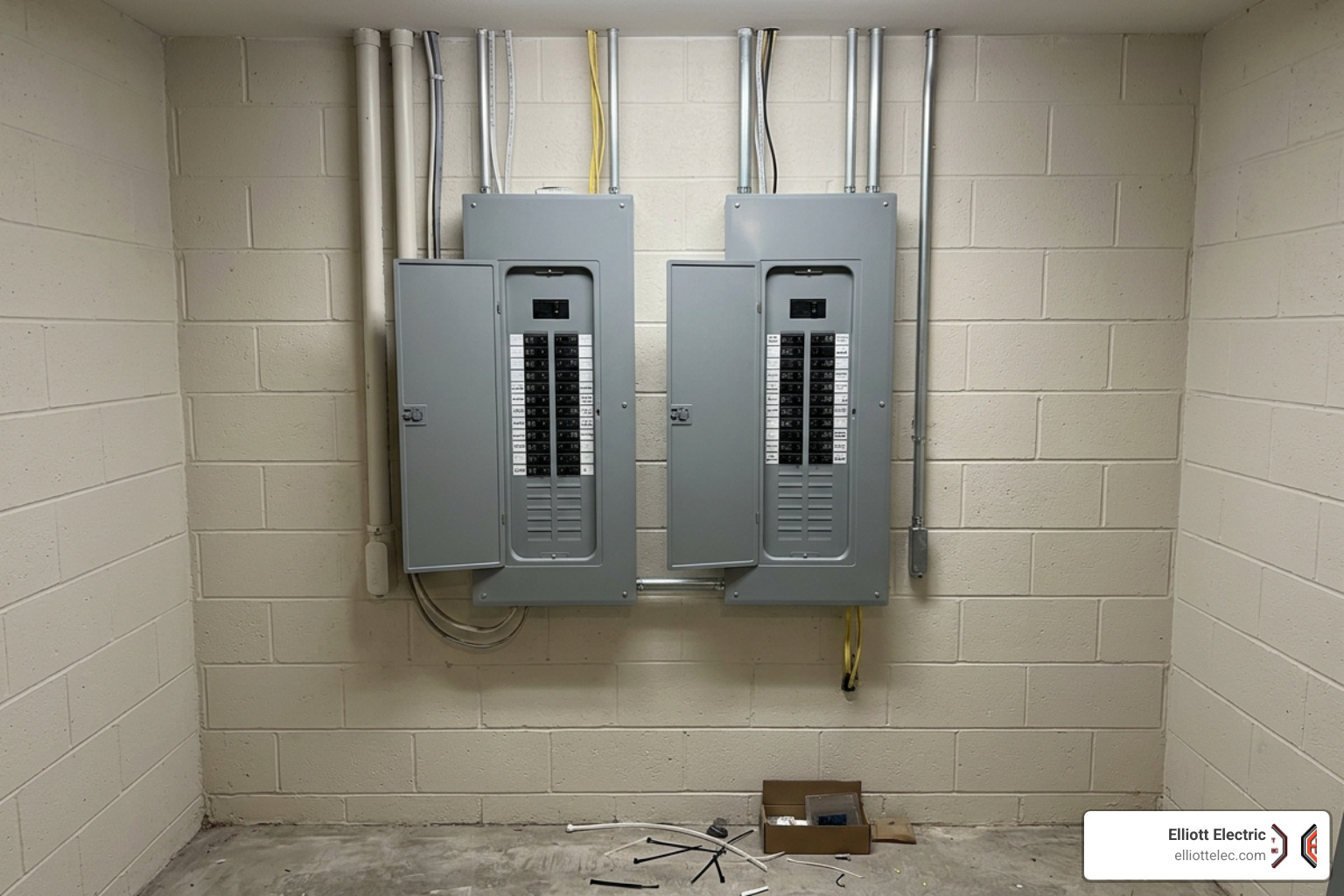
To help you visualize the differences, here is a direct comparison of the two configurations:
| Feature | Single 400A Panel | Dual 200A Panels (Split Service) |
|---|---|---|
| Equipment Cost | Extremely High (Industrial pricing tier) | Low to Moderate (Mass-produced commodity hardware) |
| Parts Availability | Poor (Often subject to long supply chain delays) | Excellent (Standard stock at any local supplier) |
| Breaker Space | Limited (Typically 40 to 42 spaces) | Massive (60 to 80+ spaces across both panels) |
| Backup Generator Integration | Complex & Expensive ($3,000+ transfer switches) | Simple & Cost-Effective ($700 transfer switch on one panel) |
| Solar & Battery Compatibility | Highly Complex (Requires specialized industrial inverters) | Standard (Natively designed for 200A systems) |
Why Dual 200A Panels Are the Industry Standard
In residential and light commercial work, dual 200A panels are overwhelmingly preferred by professional electricians. The primary reason comes down to basic economics and supply chain logistics.
Because 200 amp panels and breakers are the standard for millions of homes across the country, they are mass-produced commodity items. They are affordable, highly reliable, and always in stock. A single 400 amp main breaker panel, on the other hand, crosses over into industrial-grade equipment. The hardware can cost up to four times as much as two 200A panels combined, and finding replacement parts down the road can be a major headache.
Dual panels also offer incredible advantages for backup power planning. If you want to install a standby generator, buying a 400-amp automatic transfer switch can easily cost over $3,000. With a dual-panel setup, we can isolate your critical loads (refrigerator, well pump, heating, select lighting) onto just one of the 200A panels. You then only need to install a standard 200-amp transfer switch (costing around $700) on that specific panel, saving you thousands of dollars in equipment costs.
Furthermore, almost all residential solar inverters and battery backup systems (like the Tesla Powerwall) are designed to integrate natively with standard 200A equipment. Trying to wire these systems into a single 400A industrial panel requires complex, custom engineering that drives up installation labor costs.
Technical Specifications: Wire Sizing, Grounding, and NEC Code Compliance
Upgrading your electrical service is not just about mounting new metal boxes on the wall. It requires strict adherence to the National Electrical Code (NEC) to ensure your system can handle the massive amount of current safely without risking electrical fires or equipment damage.
Wire Sizing and Material Selection for 400A Service
Choosing the right wire size is critical because undersized wires will overheat, drop voltage, and potentially cause a catastrophic failure. The wire size you need depends on whether you are running copper or aluminum conductors, the length of the run, and whether the lines are overhead or underground.
For a single run supplying a 400-amp service, standard specifications typically require:
- Copper Conductors: 600 kcmil (thousand circular mils) wire.
- Aluminum Conductors: 1,000 kcmil wire.
Because pulling massive 1,000 kcmil aluminum wire through conduit is incredibly difficult, most electricians opt to run parallel service entrance conductors. This means running two parallel sets of smaller, more flexible wires. For a parallel setup, we typically use two sets of 3/0 copper or 250 kcmil aluminum wires. For a highly detailed look at these calculations and options, refer to the 400 amp wire sizing guide.
We must also calculate potential voltage drop over long distances. NEC guideline 210.19(A)(1) recommends keeping voltage drop under 3% for feeders. If your meter base is located far from the utility pole or your subpanels are deep inside a large property, we must increase the wire gauge to compensate for resistance over the distance.
Grounding and Bonding Requirements
When you upgrade to a 400 amp service, the potential fault current (the amount of electricity that can flow during a short circuit) increases dramatically. To protect your property and electronic equipment, the entire grounding and bonding system must be rebuilt to meet current NEC standards.
During an upgrade, we must:
- Drive New Ground Rods: We install two copper-clad ground rods driven at least 8 feet into the earth, spaced at least 6 feet apart.
- Upgrade Grounding Electrode Conductors: The copper wire connecting your main service disconnect to your ground rods must be sized up to handle the higher capacity.
- Update Water and Gas Bonds: We must run heavy-duty bonding jumpers to your metal water mains and gas piping. This ensures that if a live wire accidentally touches a metal pipe anywhere in your building, the current is safely directed into the earth, instantly tripping the breaker rather than electrifying your plumbing.
The Installation Process: Timeline, Permits, and Utility Coordination
A 400 amp service upgrade is a highly coordinated dance between our team of electricians, your local municipal inspectors, and your utility provider (such as Dominion Energy or Duke Energy in our Virginia and North Carolina service areas).
Here is a look at what the step-by-step process actually looks like:
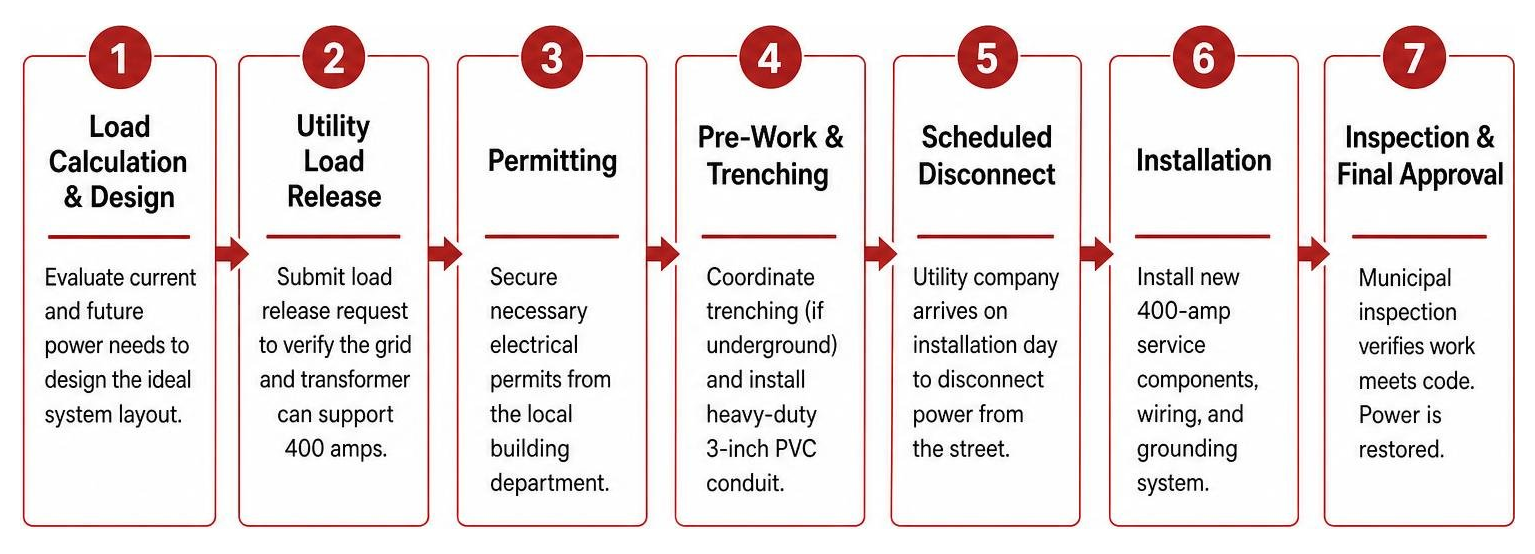
- Load Calculation & Design: We evaluate your current and future power needs to design the ideal system layout.
- Utility Load Release: We submit a load release request to the utility company to verify that the local grid and your street’s transformer can handle a 400-amp draw.
- Permitting: We secure the necessary electrical permits from your local building department (e.g., Halifax County, Danville, or South Boston).
- Pre-Work & Trenching: If your service is underground, we coordinate any necessary trenching and lay the heavy-duty 3-inch PVC conduit.
- The Scheduled Disconnect: On the day of installation, the utility company arrives to disconnect the power from the street.
- Physical Installation: Our crew removes your old meter base and panels, mounts the new Class 320 meter socket, installs the dual 200A panels, pulls the heavy service entrance conductors, and completes all grounding and bonding.
- Electrical Inspection: A local building inspector reviews our work to sign off on safety and code compliance.
- Reconnection: Once the inspector approves the job, the utility company reconnects the live service drop and installs your new digital meter.
To learn more about how our licensed professionals handle this complex process safely, visit the page About our local electrical team.
Frequently Asked Questions about High-Amperage Upgrades
Navigating a major electrical project naturally brings up plenty of questions. Here are the clear, honest answers to the most common queries we receive from property owners.
How much does a 400 amp service upgrade cost?
The cost of upgrading to a 400 amp service typically ranges from $5,000 to $15,000, with highly complex installations reaching up to $20,000.
Your final investment is influenced by several critical variables:
- Utility Requirements: Some utilities provide the meter box for free, while others charge for connection fees.
- Transformer Upgrades: If your local utility company determines that the street transformer cannot support your new 400-amp load, they may charge you to replace it. This is a common hidden cost that can add thousands to a project.
- Conduit Runs and Trenching: Running overhead lines is generally much cheaper than digging trenches for underground lines, especially if we have to cut through concrete or asphalt.
- Interior Rewiring: If your existing panels are located in an area that no longer meets modern NEC clearance codes, we may have to relocate the panels, requiring us to extend all of your home’s branch circuits.
For a detailed breakdown of national pricing trends and material costs, check out this comprehensive 400 amp service cost guide.
Does upgrading to 400 amp service increase property value or lower electric bills?
Upgrading your electrical service does not directly lower your monthly electric bill. A kilowatt-hour of electricity costs the same whether it flows through a 100A, 200A, or 400A panel. However, an upgraded panel does prevent energy loss from heat dissipation that occurs when a smaller panel is constantly running at its absolute physical limit. It also allows you to install highly efficient modern appliances, like hybrid heat pump water heaters and variable-capacity HVAC systems, which will lower your monthly bills.
When it comes to property value, a 400 amp upgrade acts as a powerful selling point. While it might not add a guaranteed dollar-for-dollar premium to your home’s appraisal, it drastically increases appeal for modern buyers who prioritize EV fast-charging, smart home features, or workshop space. In many cases, having an outdated, overloaded panel can actively stall a sale or force you to offer costly repair credits during negotiations.
Can a 400 amp service support multiple EV chargers and workshops?
Absolutely — in fact, this is the primary reason most property owners choose to upgrade.
A single Level 2 EV charger typically draws 40 to 50 amps. If you have two electric vehicles charging simultaneously overnight, they can easily pull 80 to 100 amps of continuous power. When you add that to your home’s standard baseline loads (heating, cooling, water heater, refrigeration), a standard 200A panel is pushed to its absolute limit.
Similarly, a serious home workshop with a 50-amp welder, a heavy-duty air compressor, a CNC machine, and dust collection systems demands industrial-level power delivery. A 400 amp service ensures you can run your shop equipment at full throttle without worrying about dimming the lights inside your home or tripping the main breaker.
Conclusion
Whether you are managing a growing commercial facility or future-proofing a large home, upgrading your electrical service is a major step toward safety, reliability, and modern efficiency.
At Elliott Electric, we bring more than 75 years of trusted experience to every project. Serving Danville, South Boston, and surrounding Virginia communities, our professional team delivers code-compliant, worry-free electrical solutions backed by our 100% satisfaction guarantee. We handle the entire process for you — from precise load calculations and permitting to securing utility approvals and executing a flawless installation.
Ready to power your next big project? Schedule your commercial electrical project in Virginia with our expert team today.


