

What a Parking Lot Lighting Contractor Does (and Why It Matters)
A parking lot lighting contractor is a licensed electrician who specializes in the design, installation, repair, and maintenance of outdoor commercial lighting systems. Here’s a quick look at what they typically handle:
- Installation – New pole and fixture setup, wiring, and permitting
- LED retrofitting – Replacing old metal halide or HPS systems with energy-efficient LEDs
- Repairs and maintenance – Fixing outages, replacing ballasts, and inspecting photocells
- Lighting design – Photometric analysis to ensure even, code-compliant coverage
- Rebate assistance – Handling utility rebate applications to offset upgrade costs
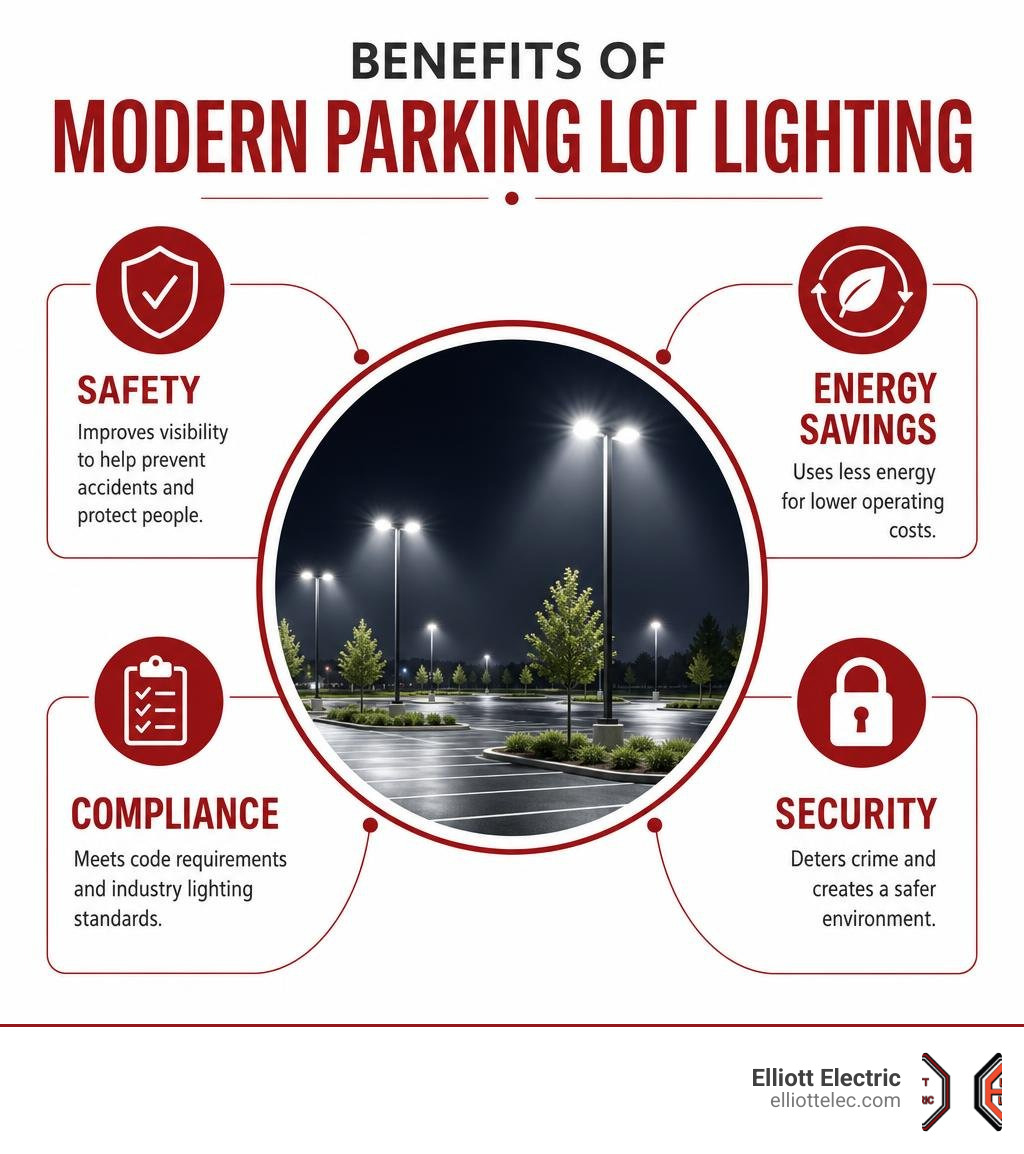
A dark or poorly lit parking lot isn’t just an inconvenience. It creates real liability — from slip-and-fall claims to security risks that drive customers away. Properly lit lots improve visibility, deter crime, and help businesses stay compliant with local codes and IES lighting standards.
At Elliott Electric, we’ve served commercial property owners across South Boston, VA and Danville, VA for years, delivering dependable parking lot lighting contractor services alongside our full suite of commercial electrical solutions. Whether you’re managing a single property or a portfolio of buildings, we’re here to make your outdoor lighting simple, safe, and cost-effective.
Why You Should Hire a Professional Parking Lot Lighting Contractor
When a light bulb goes out in your office, you grab a step stool and change it. But when an entire row of parking lot lights goes dark, the solution isn’t quite so simple. Parking lot lighting systems operate on high-voltage electrical circuits, are mounted on towering steel or concrete poles, and require specialized tools and machinery to access. Attempting a DIY fix on these commercial systems is not only dangerous; it can lead to code violations, expensive design mistakes, and severe safety hazards.
Hiring a professional parking lot lighting contractor ensures your exterior lighting is handled safely, efficiently, and in full compliance with local municipal codes. Outdoor lighting systems must withstand harsh weather conditions, wind loads, and thermal expansion. Professionals understand how to calculate the correct electrical loads, lay down underground conduits, and secure structural foundations for poles so they don’t lean or collapse.

Furthermore, specialized equipment is required to perform high-reach electrical work safely. Professional contractors utilize fully equipped bucket trucks and scissor lifts to reach fixture heights ranging from 15 to 40 feet. This specialized machinery allows technicians to repair fixtures, run wiring, and replace heavy components without putting your property or staff at risk.
If you are planning to upgrade your commercial facility or need specialized electrical help, partnering with a certified local team is key. You can explore our extensive experience with large-scale installations on our page detailing Commercial Electrical Projects Virginia.
Core Services Offered by a Parking Lot Lighting Contractor
A commercial electrical contractor does far more than just climb ladders and screw in light bulbs. A comprehensive contractor offers a full range of services designed to keep your exterior environment bright, safe, and efficient:
- Pole Installation and Structural Repair: Securing concrete foundations (sonotubes), erecting steel or aluminum poles, and repairing structural damage caused by wind, moisture, or vehicular impacts.
- Underground Wiring and Troubleshooting: Locating and repairing faults in subterranean conduits, running new electrical feeders, and managing power distribution panels.
- Ballast and Driver Replacement: Diagnosing and replacing faulty ballasts in traditional High-Intensity Discharge (HID) fixtures or installing modern electronic LED drivers.
- Photocell and Time Clock Calibration: Installing and programming light sensors and automated timers to ensure your lights turn on at dusk and off at dawn, preventing energy waste during daylight hours.
- LED Retrofitting and Upgrades: Converting energy-guzzling metal halide or high-pressure sodium (HPS) fixtures to high-efficiency LED systems.
- Routine Inspections and Audits: Performing monthly or quarterly visual inspections, structural checks, and electrical diagnostic testing to catch minor issues before they turn into costly outages.
If you need a trusted commercial electrician to inspect your current system, our teams at South Boston Commercial Electrician HVAC Plumbing and Commercial Electrician HVAC Plumbing Danville VA are always ready to assist.
How a Parking Lot Lighting Contractor Handles Emergency Repairs and Outages
When a severe storm sweeps through Virginia or a delivery truck accidentally backs into a light pole, you need immediate assistance. A dark parking lot is an instant liability and a security hazard. Professional contractors are equipped to handle emergency repairs and outages with speed and precision.
First, the contractor will dispatch a service crew with a bucket truck to secure any immediate hazards—such as exposed high-voltage wiring, dangling fixtures, or structurally compromised poles. Once the area is safe, technicians use specialized diagnostic tools to trace the outage. This might involve checking the main commercial distribution panel, testing photocells, or using underground fault locators to find broken wiring beneath the asphalt.
In cases where a pole has been completely knocked down, the contractor handles the entire replacement process. This includes clearing the debris, pouring a new concrete foundation if necessary, running new wiring, and installing a code-compliant pole and fixture. If a permanent repair will take time due to permitting or custom equipment orders, your contractor can arrange temporary lighting solutions or coordinate backup generator connections to keep your property illuminated and secure in the interim.
Enhancing Safety, Security, and Compliance in Commercial Lots
Visibility is the absolute backbone of property safety. When customers, employees, or visitors step into your parking lot at night, their sense of safety is directly tied to how well they can see their surroundings. Dark corners, deep shadows, and flickering lights invite criminal activity and increase the risk of vehicle break-ins or personal assaults.

Properly designed exterior lighting acts as a powerful crime deterrent. It ensures that security cameras can capture clear, high-resolution footage and allows pedestrians to spot potential hazards from a distance. Additionally, well-lit pedestrian pathways, walkways, and driving lanes significantly reduce slip-and-fall incidents, which are among the most common sources of liability claims for commercial property owners. By eliminating dark spots and shadows, you protect your visitors and shield your business from costly lawsuits.
Understanding IES Lighting Standards and Local Regulations
Designing a parking lot lighting system isn’t a matter of guesswork. Professional contractors design systems according to the strict guidelines established by the Illuminating Engineering Society (IES), specifically the IES RP-20 standard (Lighting for Parking Facilities). These guidelines dictate the required light levels—measured in foot-candles (fc)—and uniformity ratios based on the activity level of your facility:
- Basic Parking Lots: Require a minimum of 0.5 to 1.0 foot-candle on the pavement, with a maximum-to-minimum uniformity ratio of 15:1. This ensures that the brightest spot in the lot is no more than 15 times brighter than the darkest spot, preventing extreme contrast.
- Enhanced Security Areas: Recommend 1.0 to 2.0 foot-candles with a tighter 10:1 uniformity ratio to provide clearer facial recognition and eliminate shadows.
- High-Activity Facilities: Such as major retail centers, schools, or hospitals, require 2.0 to 5.0 foot-candles with a highly uniform 4:1 ratio to accommodate dense pedestrian and vehicular traffic.
In addition to IES standards, commercial properties must comply with local building codes, energy codes like ASHRAE 90.1, and “Dark Sky” ordinances. ASHRAE 90.1 limits the total power density (watts per square foot) allowed for exterior lighting and mandates automatic controls that reduce lighting output by at least 50% during unoccupied late-night hours.
Dark Sky compliance requires the use of full-cutoff fixtures that direct light strictly downward, preventing light pollution, glare, and light trespass (where light spills over onto neighboring residential properties).
The Role of Photometric Analysis in Lighting Design
To guarantee that your new or retrofitted lighting system meets all local codes and IES standards, contractors utilize a process called photometric analysis. Using advanced specialized software, engineers create a highly accurate digital rendering of your property.
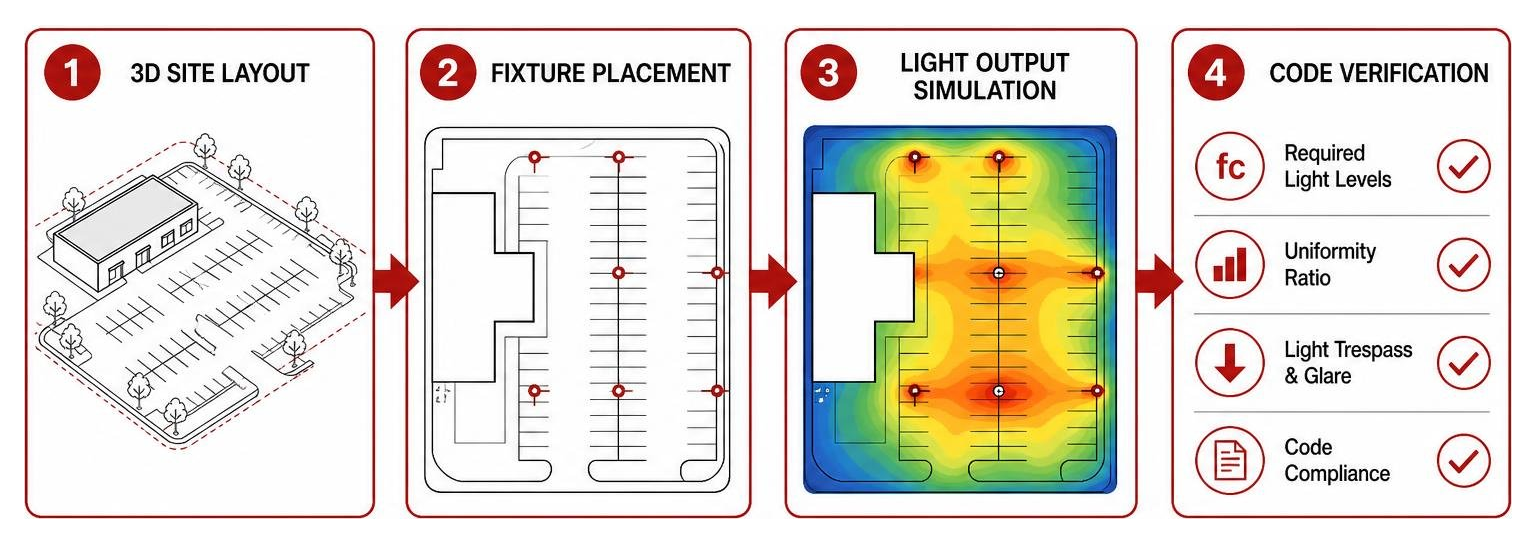
By inputting the exact dimensions of your parking lot, the positions of existing trees, buildings, and property lines, the software can simulate how light will behave across the site. The analysis determines:
- The exact number and height of light poles required.
- The precise placement and spacing of each pole.
- The ideal fixture wattages and beam angles (such as Type III-M distribution for wide, uniform coverage).
- The exact foot-candle levels across every square foot of the pavement.
This data-driven precision eliminates dead zones and shadows before a single pole is anchored or a single wire is run, ensuring your system performs flawlessly from day one.
The Financial and Environmental Benefits of LED Retrofitting
If your commercial property is still relying on older High-Intensity Discharge (HID) lighting systems—such as metal halide or high-pressure sodium bulbs—you are spending far more on energy and maintenance than necessary. Transitioning to modern Light Emitting Diode (LED) technology is one of the smartest investments a business owner can make.
LED fixtures deliver superior light quality, producing a bright, uniform white light that mimics natural daylight. This drastically improves color rendering (CRI), making it easier for people to see clearly and for security cameras to record accurate colors. Environmentally, LEDs help businesses dramatically shrink their carbon footprint. They contain no toxic mercury, produce minimal heat, and require far less electricity to operate, aligning your business with modern sustainability goals.
To see how much of a difference this upgrade makes, let’s compare traditional metal halide systems with modern LED parking lot lights:
| Feature | Traditional Metal Halide (HID) | Modern LED Fixtures |
|---|---|---|
| Average Lifespan | 15,000 hours | 50,000 to 100,000 hours |
| Energy Consumption | High (e.g., 400W–1,500W per fixture) | Extremely Low (e.g., 100W–450W for equivalent output) |
| Lumen Maintenance | Rapid degradation (loses up to 50% brightness halfway through life) | Excellent (retains over 70% brightness up to 100,000 hours) |
| Color Rendering Index (CRI) | Poor (typically 60 or lower; distorts colors) | High (70 to 80+; crisp, natural daylight representation) |
| Maintenance Frequency | Requires bulb/ballast replacement every 2–3 years | Virtually maintenance-free for 10–15 years |
| Warm-Up Time | 5 to 15 minutes to reach full brightness | Instant-on; no warm-up or restrike delays |
As shown in the table, replacing an older system with a high-performance fixture—such as those detailed on the 450W High Voltage LED Parking Lot Light – 1,500W MH Equivalent – 65,250 Lumens – 5000K – Type III-M Distribution – Optional Photocell | Super Bright LEDs product page—can slash energy usage by up to 80% while providing incredibly bright, uniform coverage.
Maximizing ROI with LED Upgrades and Utility Rebates
The initial cost of an LED retrofit is quickly offset by the massive operational savings it generates. Most commercial clients see a complete return on investment (ROI) within 18 to 36 months.
Because LED fixtures can last up to 100,000 hours, you will virtually eliminate the recurring costs of buying replacement bulbs, replacing failed ballasts, and hiring bucket trucks for high-reach maintenance. Over a decade, these savings can add up to tens of thousands of dollars.
To make the transition even more affordable, many local utility providers offer lucrative rebate programs for commercial energy-efficiency upgrades. By choosing fixtures certified by the DesignLights Consortium (DLC)—such as DLC 5.1 Premium listed products—your project may qualify for prescriptive or custom utility rebates. These rebates can cover a significant portion of the upfront fixture and installation costs, speeding up your ROI timeline.
A professional contractor will handle the complex rebate paperwork and load calculations for you, ensuring you secure every dollar of savings available.
Best Practices for Parking Lot Lighting Maintenance and Cost Management
Managing the costs of your parking lot lighting involves two key phases: smart planning during the initial installation and proactive maintenance over the system’s lifespan.
When planning a new installation, several factors will influence the overall cost, including the height and material of the poles, the total fixture count, the condition of the existing underground wiring, and the ease of access for heavy lift equipment. If trenching is required to lay new conduit through asphalt, costs will naturally be higher than retrofitting existing poles.
Once your system is installed, the best way to keep long-term costs low is to avoid major, unexpected breakdowns through proactive, scheduled maintenance. Waiting for an entire section of your lot to go dark before calling an electrician is a recipe for high emergency repair bills and increased liability risks.
To learn more about the history of our company and our commitment to quality service in Virginia, check out About Elliott Electric South Boston Danville.
Recommended Inspection and Maintenance Schedules
To keep your parking lot lighting system operating at peak performance and ensure 100% uptime, we recommend implementing a structured, proactive inspection schedule:
Monthly Visual Checks
- Walk or drive through the lot at night to identify any burned-out fixtures, flickering lamps, or misaligned heads.
- Verify that photocells are clean and functioning so lights turn on and off at the correct times.
Quarterly Technical Inspections
- Inspect poles for structural integrity, checking for signs of rust, base-bolt corrosion, or hairline cracks in concrete bases.
- Clean dirty lenses and fixtures to maximize light output (dirt buildup can reduce delivered lumens by up to 10% to 20% over time).
- Test automatic controls, dimming systems, and time clocks.
Annual Electrical Audits
- Have a licensed commercial electrician open the handholes at the base of the poles to inspect wiring connections for moisture, pest damage, or thermal wear.
- Perform voltage and amperage checks to ensure circuits are not overloaded.
- Apply protective coatings or pole painting to prevent rust and extend the lifespan of your structural assets.
Frequently Asked Questions about Parking Lot Lighting
How much does it cost to install or repair parking lot lights?
The cost of installing or repairing parking lot lights varies widely based on several key factors. A simple repair, such as replacing a single LED driver or photocell, may only cost a few hundred dollars. However, installing a brand-new light pole from scratch can range from $3,000 to $8,000+ per pole.
This installation cost includes pouring a concrete foundation, trenching through asphalt to lay conduit, running high-voltage wiring, purchasing the steel or aluminum pole, and mounting the fixture. Working with an experienced contractor who can utilize existing infrastructure can significantly lower these costs.
What are Dark Sky compliant lighting fixtures?
Dark Sky compliant fixtures are outdoor light fixtures designed to minimize light pollution, glare, and light trespass. They feature a “full cutoff” design, meaning the fixture housing completely shields the bulb so that no light is emitted upward into the night sky. Instead, 100% of the light is directed downward and outward onto the target area.
These fixtures help preserve the natural night environment, reduce glare for drivers on nearby roads, and ensure your business complies with local municipal environmental codes.
Can parking lot lighting be automated or controlled remotely?
Yes, modern parking lot lighting can be highly automated. Contractors can integrate smart wireless controls, advanced photocells, programmable time clocks, and motion sensors into your system.
With wireless lighting management, you can schedule specific dimming profiles (such as lowering light levels by 50% after midnight when your business is closed) and receive instant, automated email or text notifications the moment a fixture goes offline. This eliminates the need for manual night inspections and keeps your energy bills as low as possible.
Conclusion
Your parking lot is the very first thing customers and employees see when they arrive at your facility after dark. Investing in high-quality, professional parking lot lighting is one of the most effective ways to protect your business from liability, enhance security, improve curb appeal, and drastically reduce your monthly energy bills.
With over 75 years of commercial electrical expertise, Elliott Electric is the premier choice for businesses throughout Danville, VA, South Boston, VA, and the surrounding areas. We provide fully licensed, code-compliant solutions backed by our highly trained professional staff and a 100% satisfaction guarantee.
Whether you need a rapid emergency repair, a detailed photometric design, or a complete LED retrofit, we have the specialized bucket trucks, diagnostic tools, and technical expertise to get the job done right.
Ready to illuminate your property and start saving on your energy bills? Contact Elliott Electric Electrical HVAC Plumbing today to speak with our local team, or visit our main directory to learn more about how we can help you Elliott Electric – Commercial Electrician HVAC Plumbing.
To get started on your next upgrade, Schedule your commercial lighting project with Elliott Electric and let us bring your business out of the dark!


