

Why Commercial Lighting Installation Is One of the Smartest Investments You Can Make
Commercial lighting installation is the process of planning, designing, and fitting a building’s lighting system — whether upgrading existing fixtures or wiring a brand-new space from the ground up.
Here’s a quick snapshot of what you need to know:
- What it involves: Facility audit, energy bill review, fixture selection, professional installation, and post-install training
- Who needs it: Office buildings, warehouses, retail stores, healthcare facilities, schools, hotels, and more
- Why it matters: Lighting accounts for roughly 17% of all commercial electricity costs in the U.S.
- Biggest benefit: LED retrofits can cut lighting energy use by 40–60%, with payback periods as short as 2–4 years
- Key add-ons: Smart controls, motion sensors, and utility rebate programs can stretch savings even further
Lighting might not be the first thing on a property manager’s mind, but it has a direct impact on energy bills, employee productivity, workplace safety, and how a space looks and feels to customers. When lighting underperforms — flickering tubes, dim parking lots, outdated fixtures running up utility bills — it creates real operational headaches across every site you manage.
The good news: a well-planned commercial lighting project doesn’t have to mean shutting down your operations or juggling a dozen vendors. With the right contractor, the process is straightforward, minimally disruptive, and delivers measurable returns quickly.
At Elliott Electric, we bring years of hands-on experience in commercial lighting installation across South Boston, VA and Danville, VA, helping property managers and business owners cut costs and stay code-compliant. We handle everything from the initial audit through final installation, so you can stay focused on running your properties.
The Business Case for Commercial Lighting Installation
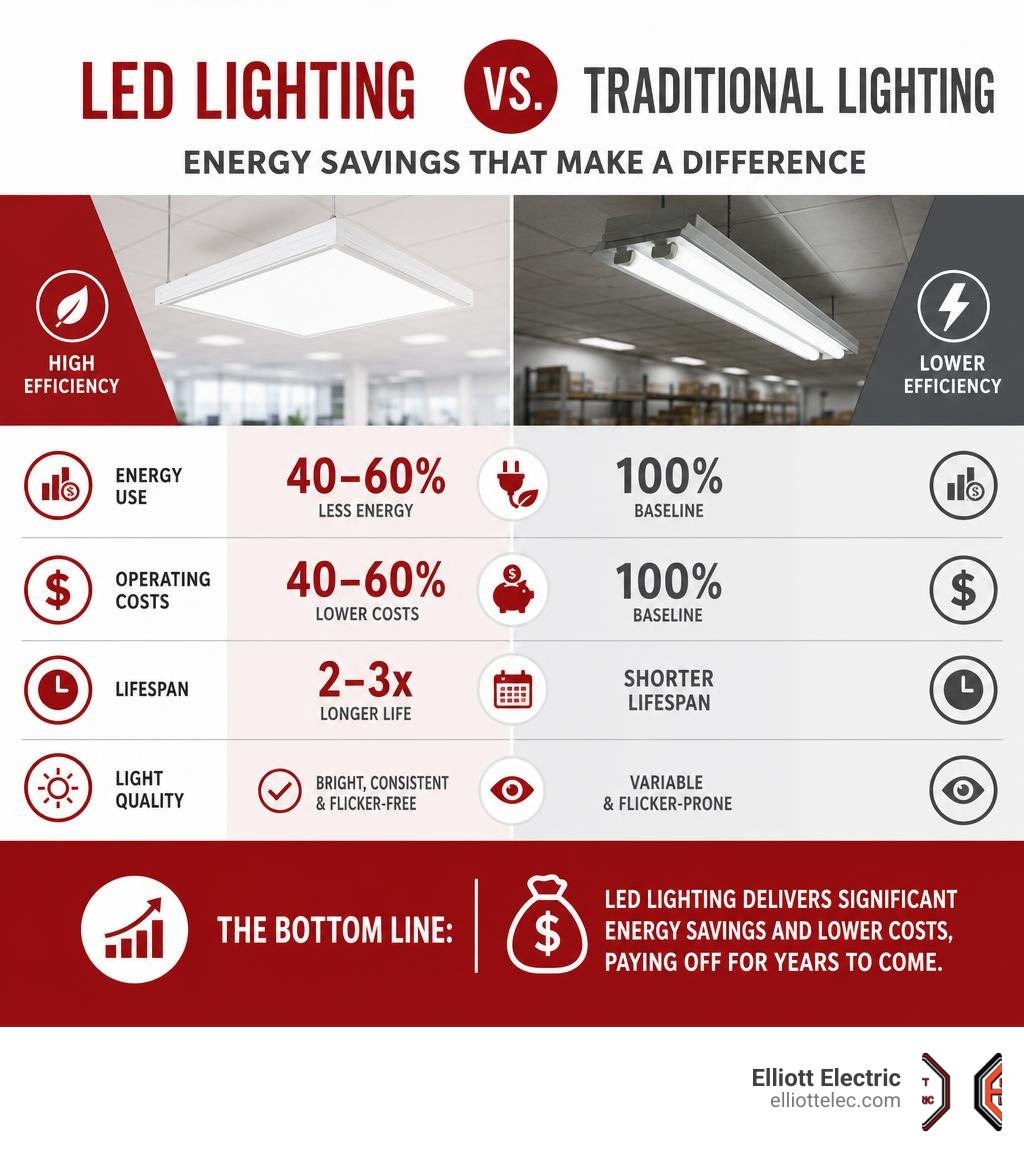
In July 2026, managing overhead is more critical than ever. The U.S. commercial building sector spends approximately $120 billion annually on electricity, and lighting accounts for 17% of that massive total. For businesses operating throughout Virginia and North Carolina, continuing to run outdated fluorescent, metal halide, or halogen systems is akin to letting money leak out of your facility’s windows.
Upgrading to modern LED systems is no longer just an environmental choice; it is a fundamental financial strategy.

Energy Savings and Rapid Payback
LED retrofits can reduce commercial lighting energy consumption by 40% to 60% compared to traditional fluorescent or incandescent systems. In heavy-duty industrial settings, replacing outdated high-pressure sodium (HPS) or high-intensity discharge (HID) lamps can slash lighting-related energy consumption by up to 80% to 90%.
These extreme efficiency gains translate directly into lower utility bills. When you factor in regional utility rebates and long-term energy savings, the average payback period for a professional commercial lighting installation ranges from just 2 to 4 years.
Furthermore, because high-performance commercial LED fixtures have an average lifespan of 50,000 to 100,000 hours—compared to 15,000 hours for fluorescent tubes and a meager 1,000 hours for incandescent bulbs—you will virtually eliminate the material and labor costs associated with frequent bulb replacements for up to a decade.
Enhancing Productivity and Workplace Safety
The quality of light in a workspace has a profound psychological and physiological effect on human beings. Proper commercial lighting design can improve employee productivity by up to 15%. Good lighting reduces eye strain, headaches, and afternoon fatigue, keeping your team feeling up to five times more alert during their shifts.
Additionally, improved visibility is a critical component of workplace safety. Nearly 3 million American workers are hurt on the job each year, with poor lighting blamed for many of the most common slips, trips, and falls. In fact, a study by the CDC showed that workers in well-lit environments detected trip hazards 94% faster. Implementing an engineered lighting design can reduce workplace accidents by up to 25%, and in high-risk industrial or manufacturing environments, upgrading your lighting can reduce safety incidents by as much as 60%.
| Feature / Metric | LED Lighting Systems | Fluorescent Systems | Incandescent Systems |
|---|---|---|---|
| Average Lifespan | 50,000 to 100,000 hours | 15,000 hours | 1,000 hours |
| Energy Consumption | Low (40-60% savings minimum) | Moderate | Very High |
| Maintenance Needs | Extremely low (up to 10 years) | Frequent ballast/bulb changes | Constant replacements |
| Heat Emission | Minimal (cool to the touch) | Moderate | High (wasted thermal energy) |
| Hazardous Materials | None | Contains Mercury | None |
| Light Direction | Directional (no reflector loss) | Omnidirectional | Omnidirectional |
If you are planning a lighting upgrade for your facility, exploring past Commercial Electrical Projects Virginia can provide valuable inspiration and show you what is possible for your local business.
Key Phases of a Professional Lighting Project
A successful commercial lighting project is not a simple matter of swapping out lightbulbs. It requires a structured, multi-phase approach executed by a licensed professional contractor to ensure code compliance, maximum energy savings, and zero operational headaches.

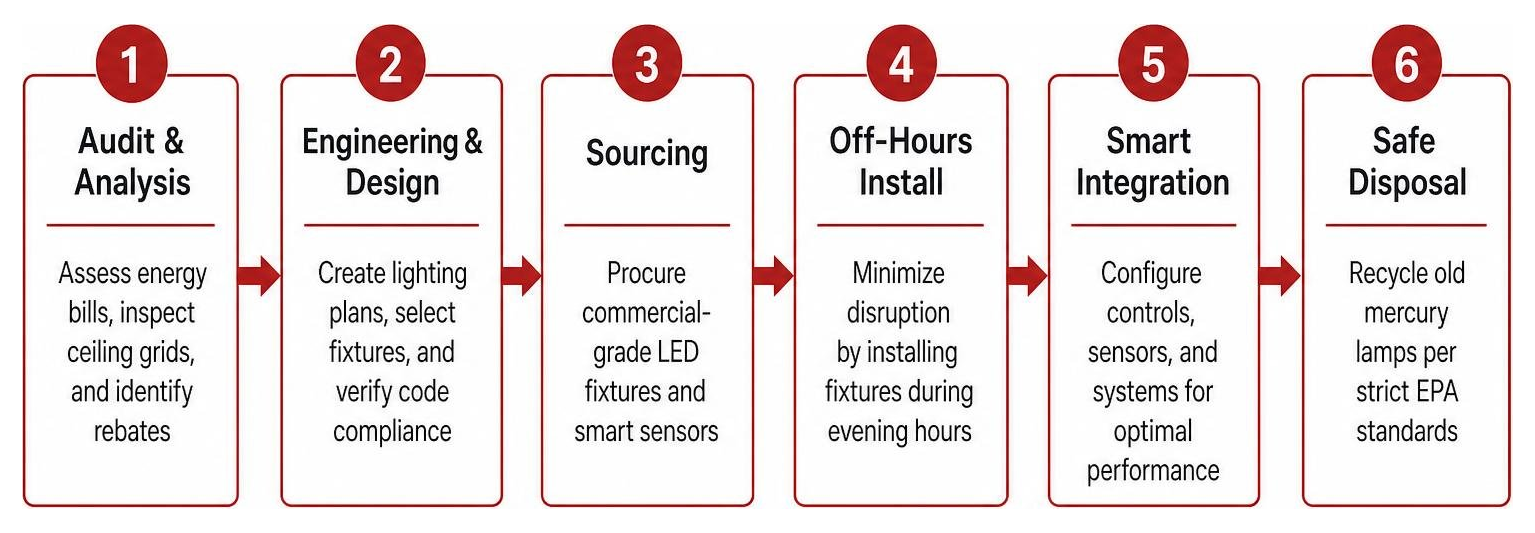
At Elliott Electric, we follow a rigorous, proven process to deliver seamless results:
- In-Person Facility Audit & Inspection: We walk your property to document every existing fixture, mounting height, beam angle, and control mechanism.
- Energy Bill Analysis: We review your historical utility data to establish an accurate baseline of your energy consumption and identify peak demand charges.
- Rebate & Financing Discovery: We identify and apply for all eligible utility rebates, government grants, and tax incentives on your behalf to lower your upfront project costs.
- Custom Lighting Design: Using CAD software, we map out a tailored layout that optimizes light placement, eliminates dark spots, and ensures the correct foot-candle levels for your industry.
- Fixture Sourcing & Installation: We procure high-quality commercial fixtures and execute the installation. To minimize disruption, our crews often work after-hours or overnight so your daily business operations continue without a hitch.
- Controls Integration & Team Education: We integrate smart sensors, dimmers, and automation systems, then walk your team through how to use them.
If you are located in Southside Virginia, reaching out to our experts for commercial electrician services in Danville, VA is the best way to kickstart this process.
Planning a Retrofit vs. New Construction Commercial Lighting Installation
While the ultimate goal of both retrofits and new construction projects is beautiful, efficient light, the execution paths differ significantly.
New Construction Packages
In new construction or major tenant buildouts, we start with a blank canvas. This allows for total freedom in architectural integration. However, it requires close coordination with general contractors, architects, and structural engineers. We must verify that the wall, ceiling, or junction boxes are structurally capable of supporting the weight of heavy commercial fixtures.
New construction also demands strict adherence to the latest building codes, energy codes (such as ASHRAE 90.1), and National Electrical Code (NEC) standards. For shallow plenum spaces common in modern offices, utilizing low-profile options like those found in the LCAT Luminaire Installation Guide allows for clean, recessed installations without interfering with HVAC ductwork.
Retrofit & Upgrade Projects
Retrofitting involves replacing or modifying existing fixtures. The challenge here is working within the constraints of your current ceiling footprint and electrical infrastructure. Retrofits are popular because they offer a much lower upfront cost and a faster return on investment.
Depending on the state of your existing housings, we may perform a “dirty retrofit” (swapping lamps and ballasts while retaining the fixture body) or a full fixture replacement to upgrade the aesthetics of your space completely.
Technical Execution of a Commercial Lighting Installation
Commercial lighting demands heavy-duty, precise electrical work. Whether installing suspended linear luminaires in a modern retail space, recessed troffers in a corporate office, or high-output downlights in a hotel lobby, safety and compliance are paramount.
Key technical requirements during installation include:
- Wiring and Grounding: All electrical enclosures, conduits, and fixtures must be grounded and bonded in strict compliance with NEC Article 600. Installers must use UL-approved wire (typically a minimum of 18 AWG) rated for the specific circuit load and environment.
- Structural Integrity: For suspended linear systems, aircraft cables must be anchored securely to the building structure, not just the ceiling grid. According to professional Suspended Mounted Luminaire Installation Instructions, continuous rows of suspended fixtures must be carefully aligned, leveled, and secured with single-use joining brackets to prevent sagging or mechanical failure over time.
- Voltage and Run Limits: Installers must respect maximum through-wiring limits to prevent voltage drops and fire hazards. For instance, continuous linear runs are typically limited to a maximum of 100 feet of luminaires on a single 120V branch circuit, or up to 200 feet on 277V/347V systems, with a hard cap of 16A passing through any connected fixture harness.
- Clearances and Ratings: Recessed downlights, such as those detailed in the CDG LED Commercial Downlight Instructions, require precise ceiling cutouts (e.g., 5.0″ for 4-inch models or 6.5″ for 6-inch models) and must maintain at least a 3-inch clearance from any combustible insulation materials unless they are specifically IC-rated (Insulation Contact).
Maximizing Efficiency with Smart Controls and Automation
If you install energy-efficient LED fixtures without smart controls, you are leaving a massive amount of money on the table. Modern commercial lighting automation acts as the brain of your electrical system, ensuring you only use energy when and where it is actually needed.
Key Automation Strategies
- Occupancy and Vacancy Sensors: These sensors automatically turn lights off in unoccupied spaces like conference rooms, restrooms, and storage areas, preventing energy waste.
- Daylight Harvesting: Photosensors detect natural light streaming in through windows and skylights, automatically dimming the adjacent LED fixtures to maintain a consistent light level while saving power.
- Zoning and Scheduling: Through smart control panels, we can program specific zones to dim or shut down entirely during non-business hours, while keeping safety and security lighting active along walkways and parking areas.
- Advanced Protocols (DMX and DALI): For complex facilities, such as theaters, multi-purpose retail spaces, or specialized environments like natatoriums, we implement Digital Addressable Lighting Interface (DALI) or DMX systems. These allow for individual, digital control over every single fixture, enabling custom light scenes, color-tuning, and automated emergency testing.
For business owners in Halifax County, partnering with a local contractor who understands these advanced technologies is essential. Our team provides specialized South Boston commercial electrical services to help local facilities design and program custom automation systems that maximize operational efficiency.
Frequently Asked Questions about Commercial Lighting
What is the average payback period for a commercial LED upgrade?
The average payback period for a commercial LED upgrade is 2 to 4 years. However, this timeline can vary based on several key factors:
- Daily Operating Hours: Facilities that run 24/7 (like warehouses, manufacturing plants, and hospitals) see a much faster return on investment—often in under 18 months—because their energy savings accumulate rapidly.
- Local Utility Rates: The higher your local electricity rates, the more money you save per kilowatt-hour saved, accelerating your ROI.
- Available Rebates: Securing upfront utility rebates can instantly knock 20% to 50% off the total project cost, drastically shortening your payback timeline.
- Maintenance Reductions: By eliminating the need to hire electricians with bucket trucks to swap out dead lamps in high ceilings or parking lots, your ongoing operational savings increase immediately.
How do local utility rebates and regional factors affect project costs?
Utility rebate programs are one of the most powerful tools available to lower the cost of a commercial lighting installation.
In our primary service areas across Virginia and North Carolina, major utility providers—such as Dominion Energy and Duke Energy—offer robust commercial energy efficiency programs. These programs provide cash incentives for upgrading old, inefficient lighting to DLC-qualified (DesignLights Consortium) LED fixtures and smart controls.
There are two primary types of rebates:
- Prescriptive Rebates: These pay a fixed, predetermined dollar amount per fixture replaced (e.g., $15 per LED troffer or $50 per high-bay fixture). They are straightforward and easy to calculate.
- Custom Rebates: These are calculated based on the total projected kilowatt-hour (kWh) savings of a unique, complex project. They are ideal for large-scale retrofits or projects incorporating advanced automation systems.
Because navigating rebate paperwork can be incredibly tedious, we handle the entire application, coordination, and submission process for our clients to ensure you receive every dollar you deserve.
What are the safety and environmental regulations for disposing of old commercial lamps?
You cannot simply throw old commercial lamps into a standard dumpster. Doing so can result in massive environmental hazards and severe legal consequences for your business.
Many traditional commercial lamps—including fluorescent tubes, compact fluorescent lights (CFLs), high-intensity discharge (HID) lamps, and older neon signs—contain mercury vapor and other heavy metals. Mercury is a potent neurotoxin that can easily contaminate local soil and water supplies if bulbs break in a landfill.
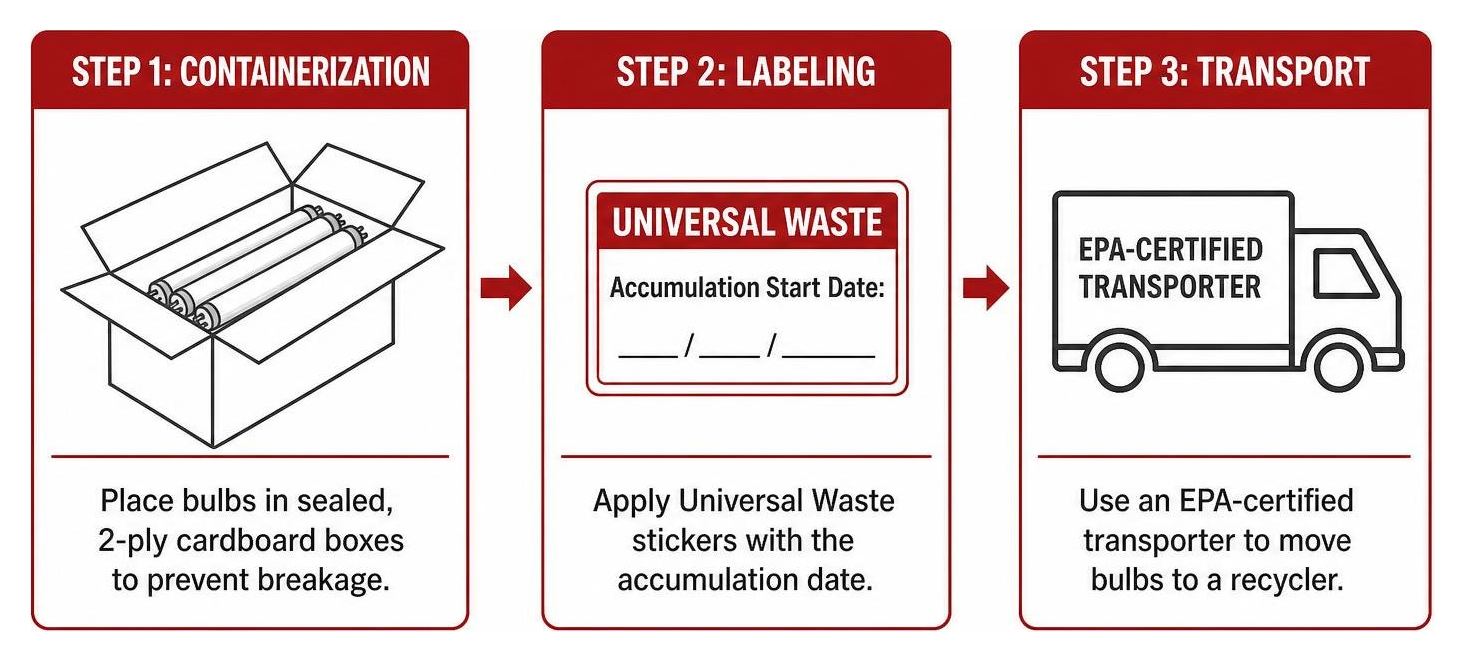
To stay compliant with strict EPA Universal Waste regulations, businesses must adhere to the following rules:
- Proper Storage: Old bulbs must be placed in sealable, 2-ply cardboard containers that are structurally sound and protect against breakage. Plastic bags or open boxes are strictly prohibited.
- Accurate Labeling: Every container must be clearly labeled with “Universal Waste – Lamps” or “Waste Lamps,” and must prominently display the date you first began accumulating the waste.
- Strict Timelines: Under EPA rules, universal waste containers cannot remain on your property for more than one year from the accumulation start date.
- Certified Transportation: You must use a registered, EPA-certified hazardous waste transporter to move the containers to an authorized recycling facility that can safely recover the glass, metals, and mercury.
- Fines for Non-Compliance: Failing to follow these regulations can result in catastrophic fines from the EPA, reaching up to $32,000 per day, per violation.
Upgrading to LED fixtures completely eliminates this ongoing compliance headache, as LEDs do not contain mercury or other hazardous universal wastes.
Conclusion
Upgrading your business’s lighting system is one of the most reliable ways to slash monthly operating costs, protect your workers, and enhance the visual appeal of your property. Whether you are running a retail shop in Danville, a manufacturing facility in South Boston, or a school campus in Halifax County, a professional commercial lighting installation pays for itself in energy savings and maintenance reduction.
At Elliott Electric, we have spent over 75 years delivering high-quality, code-compliant electrical, HVAC, and plumbing solutions to businesses across Virginia and North Carolina. Our professional staff is dedicated to executing your project safely, on time, and with minimal disruption to your daily operations. Plus, we back all of our work with our signature 100% satisfaction guarantee.
Ready to stop wasting money on outdated lighting? Schedule your commercial lighting installation with Elliott Electric today and let us help you design a brighter, more efficient future for your business.


