

What You Need to Know About Commercial HVAC Rooftop Units
Commercial HVAC rooftop units are self-contained heating, cooling, and ventilation systems mounted on the roof of a building — and for most commercial property managers, they’re the backbone of indoor comfort across every site they oversee.
Here’s a quick snapshot of what they are and why they matter:
| Feature | Details |
|---|---|
| What they are | Packaged units combining heating, cooling, and ventilation in one cabinet |
| Where they’re installed | Mounted on rooftops, connected to ductwork below |
| Capacity range | 2 to 150 tons, covering small retail to large industrial buildings |
| Common configurations | Cooling-only, gas/electric, heat pump, dual-fuel |
| Efficiency ratings | Measured in SEER2, IEER, and EER2 |
| Modern refrigerants | R-454B and R-32 (replacing older R-410A) |
| Typical lifespan | 15 to 20 years with proper maintenance |
These units are popular because they keep all the mechanical equipment off the floor and out of the way — freeing up interior space and simplifying service access.
Managing multiple buildings means you need systems that are reliable, code-compliant, and easy to service without coordinating a dozen different contractors. That’s exactly where understanding your RTU options pays off.
At Elliott Electric, we’ve spent decades delivering commercial HVAC rooftop unit installations, replacements, and maintenance services for businesses in South Boston and Danville, Virginia. Whether you’re upgrading aging equipment or troubleshooting a system mid-season, we’re the single-source team that handles it all — HVAC, electrical, and plumbing — so you’re never juggling contractors across your sites.
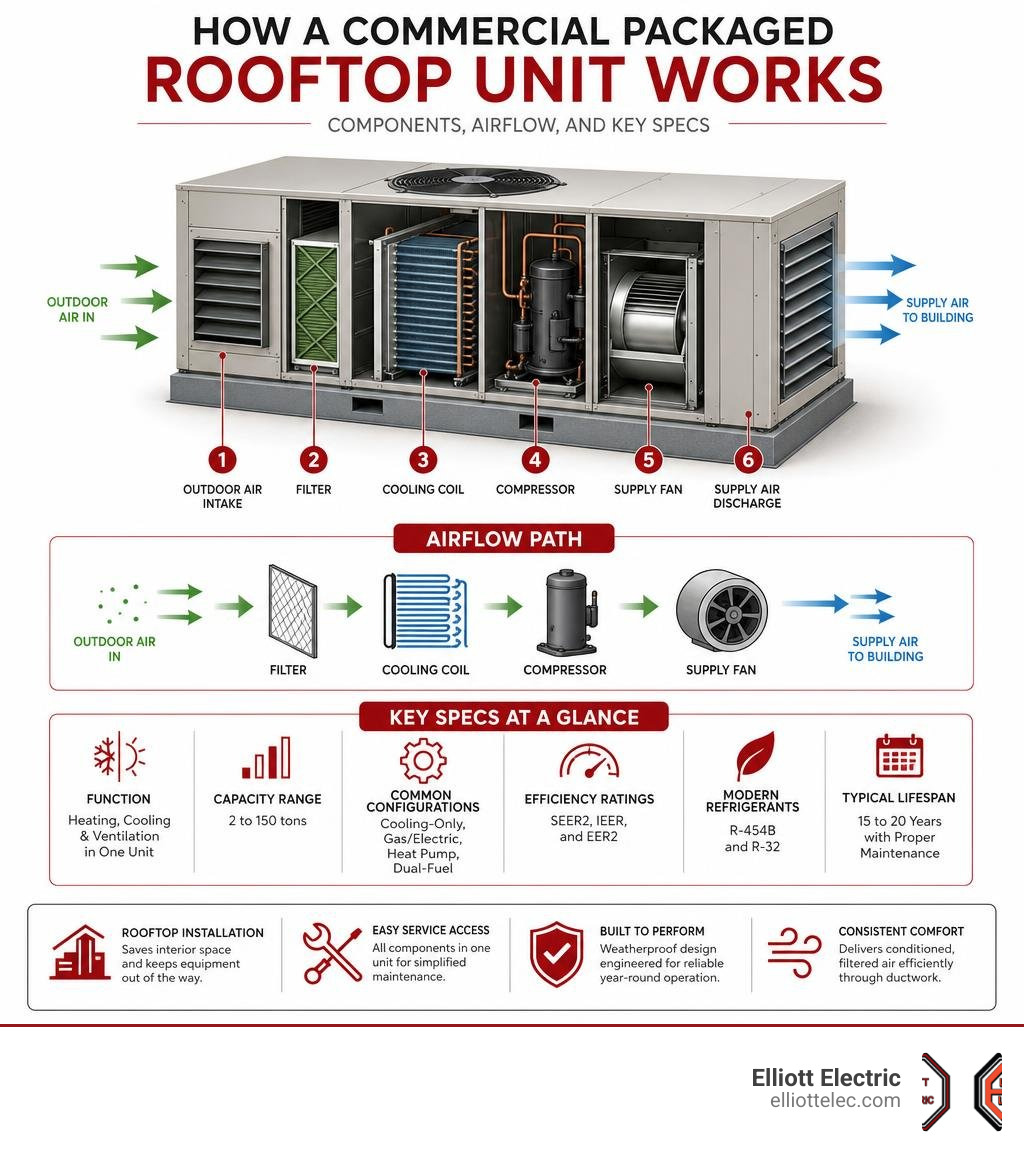
What is a Packaged Rooftop Unit and How Does It Work?
At its core, a commercial rooftop unit (often abbreviated as an RTU) is a weatherproofed, self-contained HVAC system. Unlike residential split systems that split the work between an indoor furnace or air handler and an outdoor condenser, an RTU houses all its components inside a single, durable metal cabinet.
Inside this single footprint, you will find:
- The Compressor: The “heart” of the cooling cycle, which pumps refrigerant through the system.
- The Condenser Coil and Fan: Located on the outdoor side to reject heat absorbed from the building.
- The Evaporator Coil: Located on the indoor side to cool and dehumidify the air.
- The Blower Fan: The powerhouse that draws air from inside your building, pushes it across the coils, and forces it back down through your supply ducts.
- Heating Elements: Depending on your configuration, this could be a gas burner assembly, electric heat strips, or a reversing valve for heat pump operation.
The process is a continuous loop. The blower fan draws warm air out of your building through return air ducts. This air is mixed with a regulated amount of fresh outdoor air, pulled through high-efficiency filters, and passed over the cold evaporator coil. The refrigerant inside the coil absorbs the heat, transforming the air into a cool, refreshing breeze that is distributed back into your workspaces.
For a deeper look at how these systems keep your business running smoothly, you can learn more about commercial air conditioning systems and how they are designed to handle heavy-duty commercial demands.
Rooftop Units vs. Air Handling Units (AHUs)
While they might look similar from a distance, RTUs and Air Handling Units (AHUs) serve different roles:
- RTUs are “Packaged” Systems: They are completely self-contained. They generate their own heating and cooling using built-in compressors, gas burners, or electric coils. They are strictly designed for outdoor, rooftop installation and are heavily weatherproofed to withstand high winds, rain, and snow.
- AHUs are Part of a “Central Plant”: An AHU is typically installed indoors (in a mechanical room or basement). It does not contain its own refrigeration compressors or burners. Instead, it relies on a central chiller or boiler system to pump chilled water or steam through its coils to condition the air.
Key Types of Commercial HVAC Rooftop Units
Choosing the right configuration for your commercial property depends on your local climate, energy goals, and existing utility connections. Here is how the four primary configurations stack up:
| Unit Type | Heating Source | Cooling Source | Best Climate | Key Benefit |
|---|---|---|---|---|
| Cooling-Only | None (or auxiliary electric) | DX Refrigeration | Extremely warm climates | Lowest upfront cost if heating isn’t needed |
| Gas/Electric | Natural Gas / Propane | DX Refrigeration | Cold winters, hot summers | High heating capacity; reliable in freezing temps |
| Heat Pump | Reversing DX Cycle | DX Refrigeration | Moderate/Temperate climates | Excellent energy efficiency; electric-only |
| Dual-Fuel | Heat Pump + Gas Furnace | DX Refrigeration | Variable climates | Automatically switches to the cheapest fuel source |
Cooling-Only and Gas/Electric Packaged Systems
In regions like Southern Virginia and Northern North Carolina, we experience hot, humid summers and moderately cold winters. This makes gas/electric systems incredibly popular. These setups combine an electric air conditioner with a built-in gas furnace.
Modern gas/electric models are engineered for extreme durability. For example, units in this category utilize aluminized or stainless steel heat exchangers to prevent rust and corrosion. If your building’s mixed air temperature drops below 45°F, a stainless steel heat exchanger is highly recommended to handle the condensation without degrading. To see how these systems are engineered, check out the 7.5 to 12.5 Tons Net Cooling Capacity − 86,000 to 138,000 Btuh Gas Input Heat Capacity − 130,000 to 240,000 Btuh specifications for a breakdown of commercial heating and cooling components.
High-Efficiency Heat Pumps and Dual-Fuel Options
As businesses look to reduce their carbon footprints, high-efficiency commercial heat pumps have become a go-to solution. Instead of generating heat through combustion, heat pumps simply move heat from the outdoor air indoors.
In temperate climates, heat pumps are exceptionally efficient. However, when temperatures plunge below freezing, standard heat pumps can lose capacity. That is where dual-fuel (or hybrid) systems shine. They utilize an electric heat pump during mild winter days and automatically switch over to a gas furnace when a cold snap hits. This dual-source approach ensures you are always heating your building using the most cost-effective utility at any given moment. For an in-depth look at A2L-compliant heat pump specifications, review this guide on PACKAGED GAS / ELECTRIC configurations.
Sizing, Capacity, and Efficiency Ratings for Commercial HVAC Rooftop Units
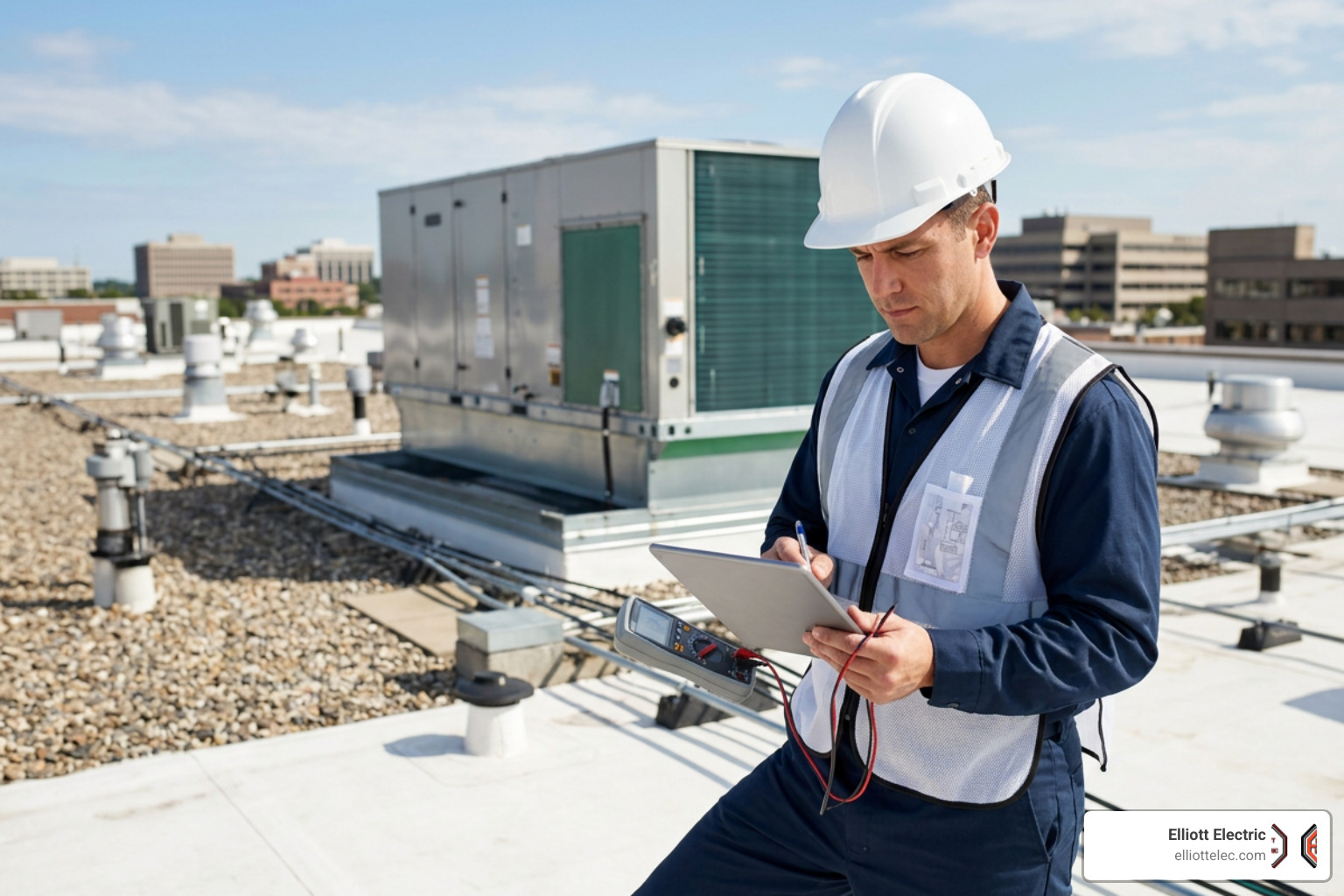
Getting the right size RTU is a balancing act. If a unit is too small, it will run constantly, driving up your electric bills and wearing out components prematurely. If it is too large, it will “short-cycle”—turning on and off rapidly. Short-cycling prevents the system from properly dehumidifying your building, leaving your indoor air feeling clammy and warm.
To prevent this, our team performs precise commercial load calculations. We look at:
- Total square footage and ceiling height.
- Building insulation levels and window orientations.
- Average and peak occupancy loads.
- Heat-generating equipment (servers, computers, lighting, cooking appliances).
- Local climate conditions in Virginia and North Carolina.
Understanding SEER2, IEER, and EER2 Ratings
When comparing commercial hvac rooftop units, you will encounter several efficiency metrics. Understanding these terms helps you calculate your return on investment:
- SEER2 (Seasonal Energy Efficiency Ratio 2): Primarily used for smaller, light commercial units (typically under 5 tons). It measures cooling efficiency over a simulated typical cooling season.
- EER2 (Energy Efficiency Ratio 2): Measures the unit’s efficiency at a single, peak operating temperature (usually 95°F). This tells you how well your system performs on the hottest afternoon of the year.
- IEER (Integrated Energy Efficiency Ratio): This is the gold standard for larger commercial units. Because commercial buildings rarely require 100% cooling capacity, IEER measures part-load efficiency at various operating stages (100%, 75%, 50%, and 25%).
Selecting a unit with high IEER ratings, such as those meeting DOE 2023 and ASHRAE 90.1 standards, can dramatically lower your monthly operational costs.
Selecting the Right Tonnage for Commercial HVAC Rooftop Units
In the HVAC world, “tonnage” refers to cooling capacity, not physical weight. One ton of cooling is equivalent to 12,000 BTUs per hour.
Commercial packaged units are highly scalable:
- Light Commercial (2 to 5 Tons): Perfect for strip malls, small offices, and corner retail stores.
- Medium Commercial (7.5 to 25 Tons): Designed for medium-sized office spaces, schools, and larger retail footprints.
- Large Applied Systems (25 to 150 Tons): Built for massive industrial facilities, hospitals, and large-scale manufacturing plants.
To explore the full spectrum of light-to-heavy commercial capacities, you can browse Commercial Packaged Rooftop Units | YORK® or view Packaged Rooftop Units options to see how manufacturers structure their product tiers.
Advanced Technology: Economizers, Smart Controls, and Low-GWP Refrigerants
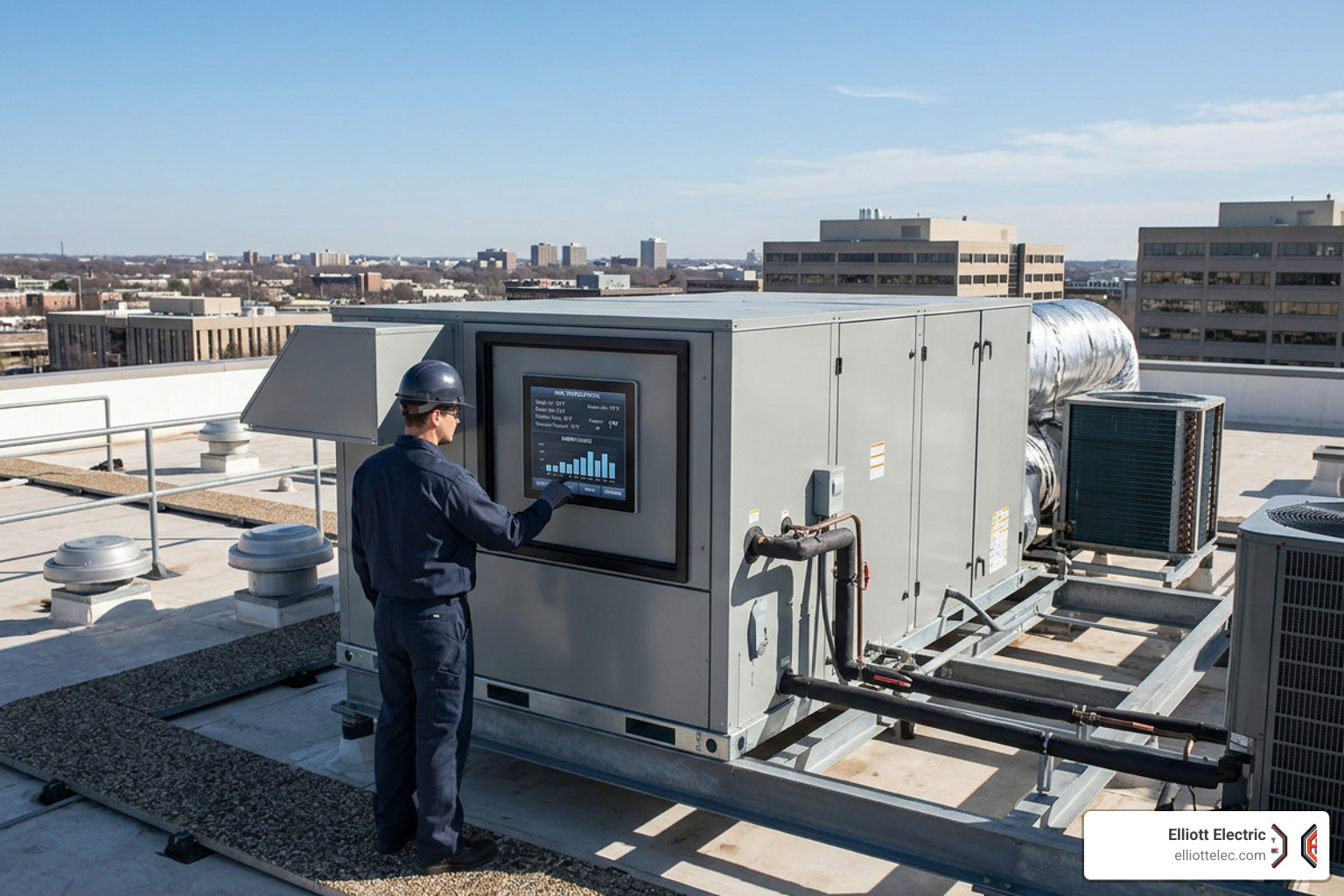
Modern commercial rooftop units are packed with smart technology designed to automate comfort and slash energy consumption.
How Economizers and Free Cooling Work
An airside economizer is essentially a smart ventilation system built into your RTU. It features a set of modulating outdoor and return air dampers controlled by temperature and humidity sensors.
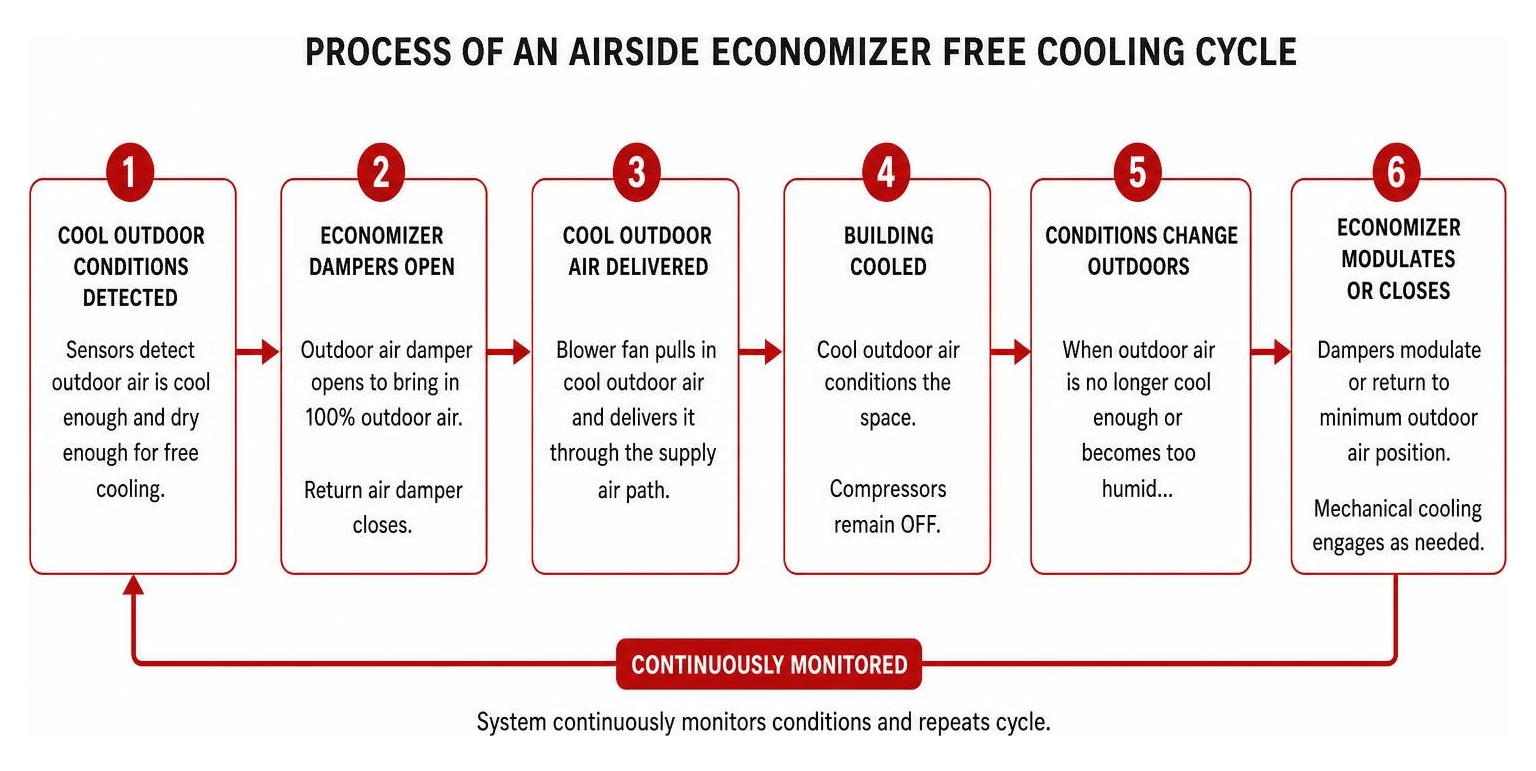
When the outdoor temperature is cool and dry (for example, a 55°F autumn morning in South Boston, VA), the economizer opens its outdoor dampers to 100%. Instead of running the energy-hungry refrigeration compressors, the blower fan draws in the cool outdoor air to condition the building for free. This is known as “free cooling.”
Additionally, economizers help maintain healthy indoor air quality by monitoring indoor CO2 levels and adjusting fresh air intake accordingly. For buildings requiring high ventilation rates, adding a heat wheel (energy recovery wheel) allows the system to pre-condition incoming outdoor air using energy from the building’s exhaust air, keeping your energy bills low.
The Transition to Low-GWP Refrigerants in Commercial HVAC Rooftop Units
The HVAC industry is undergoing a major regulatory transition to environmentally friendly, low Global Warming Potential (GWP) refrigerants. Older systems running on R-410A are being phased out in favor of next-generation A2L refrigerants like R-454B and R-32.
Because A2L refrigerants carry a “lower flammability” classification, modern RTUs are engineered with advanced safety systems:
- Refrigerant Detection Systems (RDS): Factory-installed sensors constantly monitor the indoor coil area.
- Automatic Mitigation: If a leak is detected, the system immediately shuts down the compressors and runs the indoor blower fan to safely disperse the refrigerant concentration.
To see how top-tier manufacturers are implementing these eco-friendly refrigerants, you can review the technical features of the WeatherMaker® Packaged Rooftop Unit | 50V | Carrier product line.
Installation, Maintenance, and Replacement Considerations
Installing or replacing a commercial rooftop unit is a major logistical project that requires specialized engineering, electrical, and rigging expertise.
When planning an installation, several physical factors must be addressed:
- The Roof Curb: This is the metal frame mounted to your building’s roof structure that supports the RTU. The ductwork connects directly through this curb. If you are replacing an old unit, finding a new model that matches the legacy footprint is critical.
- Ductwork Alignment: Properly sealing the connection between the RTU and the roof curb prevents air leaks and water intrusion.
- Electrical Configuration: Commercial properties typically run on three-phase electrical power. Ensuring your unit’s voltage matches your building’s supply is essential for motor and compressor reliability.
For a detailed look at physical rigging and structural requirements, check out this guide on Rooftop Unit Installation .
Essential Maintenance Checklist for Commercial RTUs
Rooftop units are exposed to harsh weather 365 days a year. Without routine maintenance, dirt buildup and mechanical wear will quickly degrade system efficiency. We recommend scheduling professional maintenance at least twice a year (typically in the spring and fall):
- Change Air Filters Monthly/Quarterly: Dirty filters restrict airflow, forcing the blower motor to work harder and reducing efficiency.
- Clean Condenser and Evaporator Coils: Dirt and pollen insulate the coils, preventing proper heat transfer.
- Inspect Belts and Pulleys: Worn or loose belts cause fan slippage and can snap, causing a system shutdown.
- Test Economizer Dampers: Ensure dampers move freely and sensors are calibrated for free cooling.
- Clear Condensate Drain Lines: Clogged drains can cause water to back up into the unit, damaging internal electrical components.
- Check Electrical Connections: Tighten electrical terminals and monitor voltage and current draws.
Replacing an Existing Rooftop Unit
When your existing RTU reaches the end of its life, planning a rapid replacement minimizes business disruption.
Our replacement strategy focuses on two main goals:
- Eliminating Transition Curbs: Whenever possible, we source direct-replacement units that match your existing roof curb footprint. This eliminates the need for expensive transition adapters, saving you thousands in sheet metal and labor costs.
- Coordinated Rigging Logistics: We coordinate crane services, local permits, and our installation crews to perform the physical swap quickly.
If your primary heating or cooling system must be offline during a major replacement, we can deploy temporary spot coolers or chillers to keep your business fully operational. If you are planning an upgrade in Southern Virginia, explore our South Boston Commercial Electrician HVAC Plumbing services to see how we streamline complex commercial changeouts.
Frequently Asked Questions About Commercial Rooftop Units
Managing commercial properties comes with plenty of questions. Here are some of the most common queries we hear from building managers in Virginia and North Carolina:
What is the typical lifespan of a commercial rooftop unit?
A well-maintained commercial RTU typically lasts 15 to 20 years. Because these units are installed outdoors, they are subjected to extreme heat, freezing winter temperatures, and high humidity. Regular preventative maintenance is the single most important factor in reaching the 20-year mark.
Can packaged rooftop units be used for dehumidification?
Yes. Commercial spaces often experience high humidity, especially during humid southern summers. Many modern RTUs feature adaptive dehumidification systems (such as hot gas reheat or modulating compressor controls) that remove moisture from the air without overcooling your indoor spaces.
What is the difference between 1-phase and 3-phase electrical power for RTUs?
Most residential homes run on single-phase (1-phase) power, while commercial facilities utilize three-phase (3-phase) power. Three-phase power provides a continuous, highly stable flow of electricity, which is much more efficient for running heavy-duty commercial motors and compressors.
When installing a 3-phase RTU, it is vital to ensure the incoming power is balanced. Operating on unbalanced power can damage variable frequency drives (VFDs) and reduce motor reliability. To protect your equipment, we recommend installing phase monitors in the unit’s electrical compartment. If you need assistance verifying your building’s electrical capacity, our team of commercial electrical experts can help. Learn more about our Commercial Electrician HVAC Plumbing Danville VA services to ensure your system’s electrical infrastructure is fully code-compliant.
Conclusion
Investing in high-quality commercial hvac rooftop units is one of the smartest decisions you can make for your commercial property. The right system keeps your occupants comfortable, ensures compliance with modern building codes, and keeps your monthly operational costs under control.
At Elliott Electric, we bring over 75 years of commercial experience to every project. Serving businesses in South Boston, Danville, and surrounding Virginia and North Carolina communities, we are your trusted partner for commercial heating, cooling, plumbing, and electrical solutions. We stand behind our work with a 100% satisfaction guarantee, ensuring your systems are engineered to last.
Ready to upgrade your building’s comfort? Partner with us for your commercial electrical and HVAC projects today, and let us help you find the perfect rooftop solution for your business.


