

Why Choosing the Right Commercial Air Units Can Make or Break Your Business
Commercial air units are the backbone of indoor comfort, air quality, and energy efficiency in any business facility. Here’s a quick overview of what you need to know:
| Type | Best For | Key Benefit |
|---|---|---|
| Packaged Rooftop Units (RTUs) | Mid-size commercial buildings | All-in-one, saves indoor space |
| Split Systems / Mini-Splits | Offices, retail, restaurants | Zoning flexibility, high efficiency |
| Air Handlers (AHUs) | Large multi-zone buildings | Precise air distribution and IAQ control |
| Air Rotation Units (ARUs) | Warehouses, large open spaces | Up to 70% energy savings, no ductwork |
| Portable / Spot Coolers | Server rooms, temporary sites | Fast deployment, targeted cooling |
Whether you manage a single office or oversee a portfolio of commercial properties, the stakes are high. A failing HVAC system on a hot July afternoon doesn’t just mean discomfort — it means lost productivity, potential equipment damage, and in some facilities, regulatory compliance issues.
Modern commercial HVAC has also grown more complex. New EPA refrigerant regulations, rising energy costs, and a wide range of system types mean the decisions you make today will affect your operating budget for years to come.
At Elliott Electric, we bring years of hands-on experience installing, servicing, and maintaining commercial air units across South Boston, VA and Danville, VA — helping business owners and property managers stay comfortable, code-compliant, and in control. In this guide, we’ll walk you through everything you need to make smart decisions for your facility.
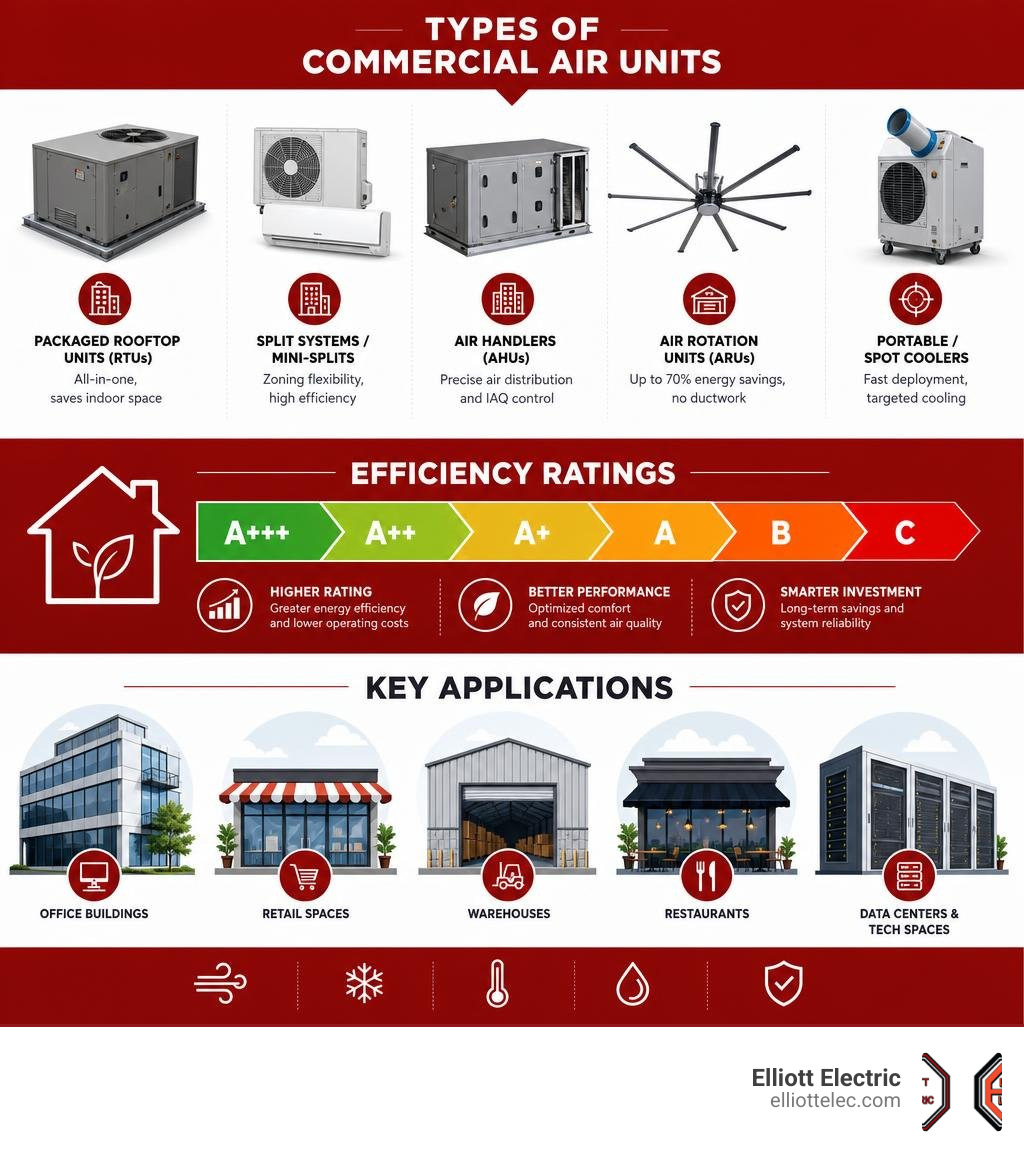
Types of Commercial Air Units for Your Business
Selecting the ideal climate control setup starts with understanding the hardware. Unlike residential systems, commercial systems must handle highly variable occupancy loads, larger square footage, and unique architectural layouts.

Packaged Rooftop Units
Commonly referred to as RTUs, packaged rooftop units are the workhorses of the commercial sector. They house all essential components—compressor, condenser, evaporator coil, and fan—in a single, self-contained weather-resistant cabinet mounted on the roof.
RTUs are highly favored for retail spaces, offices, and mid-sized buildings because they save valuable indoor floor space and keep mechanical noise far away from employees and customers. They typically ship in a downflow (vertical) configuration but can be easily field-converted to horizontal airflow to accommodate unique building footprints. RTUs can serve single-zone layouts or be integrated with variable air volume (VAV) systems to handle multi-zone configurations.
Split Systems and Ductless Mini-Splits
If your building lacks the structural support for a heavy rooftop unit, or if you require precise temperature control across different rooms, split systems are an exceptional alternative. These systems divide components between an outdoor condenser and one or more indoor air-handling units.
For light commercial spaces like boutiques, restaurants, and medical offices, high-efficiency heat pump systems provide exceptional flexibility. Systems like the Daikin SkyAir allow you to pair a single, whisper-quiet outdoor inverter heat pump with various indoor styles—including sleek wall-mounted units, concealed ducted systems, and round-flow ceiling cassettes that distribute air evenly across 360 degrees. With piping runs extending up to 230 feet and height separations up to 98 feet, outdoor units can be placed discreetly away from customer view.
Air Handlers and Air Rotation Units
Large-scale facilities demand specialized air distribution. A commercial air handler (AHU) is a large metal box containing blowers, heating/cooling coils, dampers, and advanced filtration. It is important to note that an AHU does not generate heating or cooling on its own; instead, it acts as the distribution hub, circulating air that has been conditioned by external chillers, boilers, or refrigerant lines.
For massive, high-ceiling spaces like manufacturing plants and distribution centers in Halifax County or Mecklenburg County, standard ducted systems can be prohibitively expensive to install. This is where Air Rotation Units (ARUs) excel.
An ARU is a floor-mounted, ductless system designed specifically for open spaces of at least 10,000 square feet with ceilings 25 feet or higher. By utilizing high-volume, low-velocity rotation, a single Trane Air Rotation Unit can effectively heat and cool up to 150,000 square feet of floor space—about four times the coverage of an average rooftop unit.
ARUs pull cool air from the floor, condition it, and throw it up to 250 feet in cooling mode (and 350 feet in heating mode) over the top of warehouse racking. This eliminates hot spots, keeps vertical temperature variance to a mere 2°F per 12 feet of height, and delivers up to 50% installation cost savings because there is no ductwork or roof curbs to install.
Sizing and Efficiency Metrics for Commercial Systems
Installing the wrong size system is a costly mistake. An undersized unit will run constantly, driving up utility bills and burning out the compressor. An oversized unit will cycle on and off rapidly, failing to dehumidify the air and creating drafty, uncomfortable spaces.
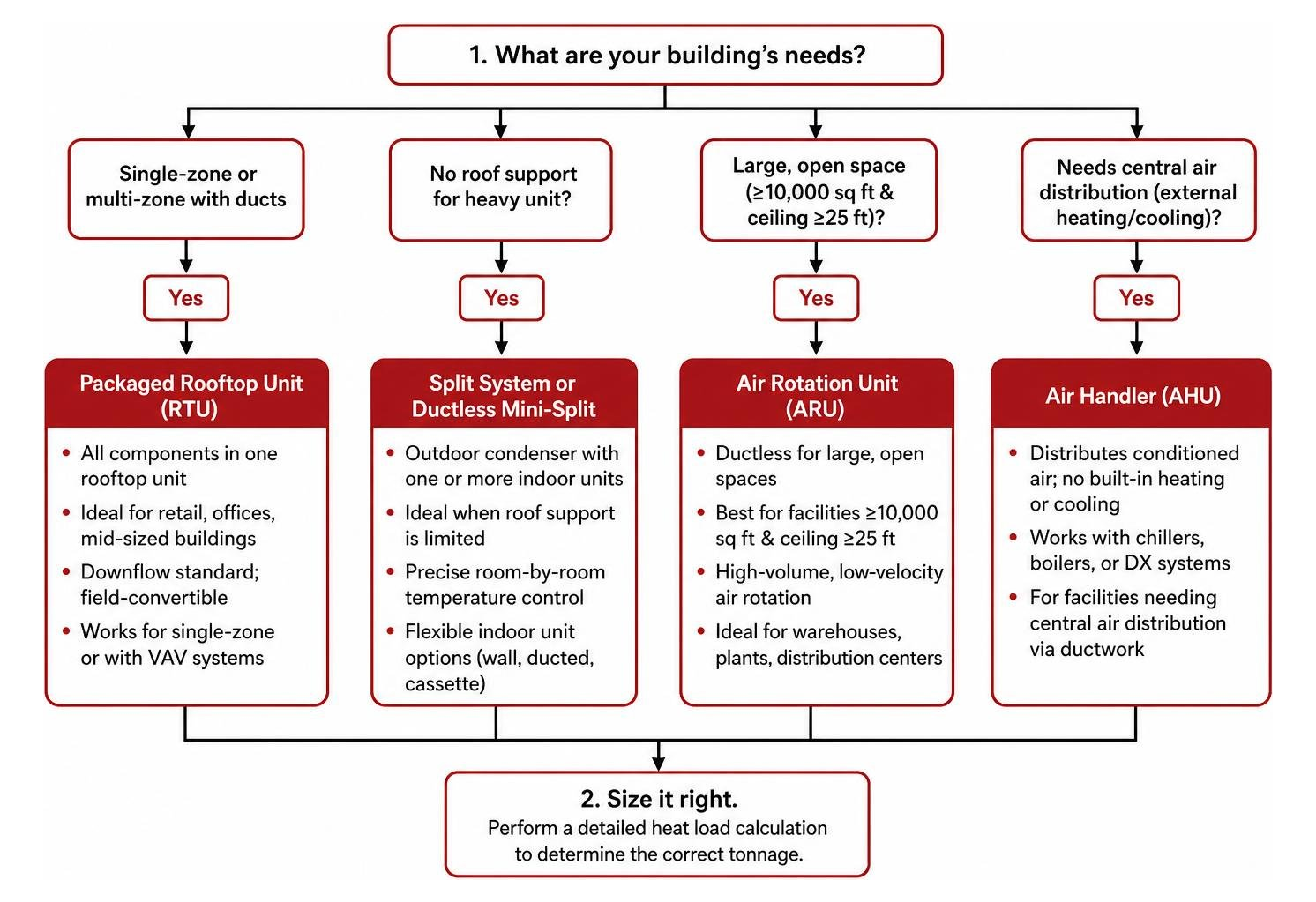
Calculating the Right Tonnage for Commercial Air Units
Commercial cooling capacity is measured in tons or BTUs (British Thermal Units), where 1 ton of cooling equals 12,000 BTUs per hour. Sizing is much more complex than a simple square-footage calculation. To find the correct tonnage, we perform a comprehensive heat load calculation that evaluates:
- Total Square Footage and Ceiling Height: Larger volumes of air require more cooling power.
- Occupancy Levels: People generate heat. A conference room or restaurant dining area requires more cooling capacity than a storage warehouse of the same size.
- Heat-Generating Equipment: Server racks, manufacturing machinery, commercial ovens, and office electronics add massive thermal loads to a space.
- Building Envelope: The quality of your insulation, the number and orientation of windows, and roof exposure all dictate how much heat enters the building.
For temporary or highly targeted cooling, businesses often turn to portable commercial air conditioners. Sizing for these units is highly standardized:
- 1 Ton: ~10,000 to 13,200 BTUs (ideal for small server closets)
- 1.5 Tons: ~16,800 BTUs
- 2 Tons: ~21,000 BTUs
- 3 Tons: ~37,000 BTUs
- 5 Tons: ~61,000 BTUs (industrial grade spot-cooling)
- 7.5 Tons: ~92,000 BTUs (heavy industrial/event cooling)
Understanding Key Efficiency Ratings
Investing in high-efficiency commercial air units delivers substantial long-term ROI. When comparing equipment, you will encounter several key performance metrics:
| Metric | What It Stands For | Why It Matters for Your Business |
|---|---|---|
| SEER / SEER2 | Seasonal Energy Efficiency Ratio | Measures cooling efficiency over a typical cooling season. Higher numbers mean lower electric bills for light commercial split systems. |
| EER | Energy Efficiency Ratio | Measures cooling efficiency at a specific, high outdoor temperature (usually 95°F). Crucial for peak-load demand planning. |
| IEER | Integrated Energy Efficiency Ratio | Evaluates part-load efficiency. Because commercial units operate at less than 100% capacity most of the time, IEER is the most accurate reflection of real-world energy use. |
| COP | Coefficient of Performance | Measures heating efficiency (ratio of heat output to energy input). A higher COP signifies a highly efficient heat pump. |
| HSPF / HSPF2 | Heating Seasonal Performance Factor | Measures the seasonal heating efficiency of heat pumps. |
Modern engineering has pushed these ratings to impressive heights. For instance, the Hitachi airCore700 light commercial system achieves an EER of up to 4.95 and a COP of up to 4.69. For larger applications requiring fresh air ventilation, Dedicated Outdoor Air Systems (DOAS) from brands like Friedrich achieve up to an impressive 21.3 IEER rating and are designed to last an industry-leading 25 years.
Ductless vs. Ducted Commercial Air Conditioning
Every commercial property has unique architectural constraints. Deciding between a ducted and a ductless system will impact your installation timeline, visual aesthetics, and monthly energy consumption.

Benefits and Drawbacks of Ducted Systems
Ducted systems rely on a network of metal or flexible ducts to distribute conditioned air from a central unit.
Benefits:
- Seamless Aesthetics: Air grilles blend quietly into drop ceilings, keeping the focus on your business’s interior design.
- Uniform Ventilation: Ideal for large, open-concept offices, retail showrooms, and school classrooms where air needs to be distributed evenly.
- Advanced IAQ Options: Central ductwork makes it easy to install commercial-grade air purifiers, humidifiers, UV-C germicidal lights, and high-efficiency MERV 13 filters.
Drawbacks:
- Energy Loss: According to energy studies, duct leakage and thermal conduction can account for up to 30% of a system’s total energy consumption.
- Higher Installation Costs: Retrofitting ductwork into an existing building requires significant structural modifications, drywall repairs, and labor.
Benefits and Drawbacks of Ductless Systems
Ductless systems deliver conditioned air directly into individual spaces from compact indoor units.
Benefits:
- Unmatched Zoning Flexibility: Multi-zone ductless systems allow you to control temperatures independently in different rooms. You can keep a restaurant kitchen cool while maintaining a warm, comfortable dining area.
- Maximum Efficiency: By eliminating ductwork, you eliminate duct-related energy losses. Systems like the modern split systems (such as the Hitachi airCore 700) utilize variable-speed inverter compressors that dynamically adjust to the cooling load, saving significant power.
- Innovative Maintenance: Premium ductless systems feature self-cleaning technologies. For example, Hitachi’s FrostWash technology freezes dust and dirt on the indoor heat exchanger, then melts and drains it away to keep airflow unrestricted.
Drawbacks:
- Visual Presence: Indoor units (whether wall-mounted or ceiling cassettes) are visible within the space.
- Higher Upfront Equipment Cost: While installation labor is lower, the cost of multiple indoor heads and advanced controls can be higher than a single packaged ducted system.
Modern Refrigerant Regulations and Environmental Impact
The commercial HVAC landscape is undergoing its most significant regulatory shift in decades. As a business owner, understanding these changes is essential to protect your investment from premature obsolescence.
The Transition to Low-GWP Refrigerants
For years, R-410A was the standard refrigerant for commercial air conditioning. However, due to its high Global Warming Potential (GWP) of approximately 2,088, environmental regulations have mandated a phase-down.
The EPA has set a strict GWP limit of 700 for refrigerants used in new heating and cooling systems. This mandate has driven the industry to transition to next-generation, low-GWP alternatives:
- R-32: A single-component refrigerant with a GWP of 675 (used in systems like the Hitachi airCore700). It offers excellent thermodynamic properties, requiring a smaller refrigerant charge while delivering higher efficiency.
- R-454B: A blend with a GWP of 466, representing a massive 78% reduction in global warming potential compared to R-410A.
How Regulations Impact New Commercial Air Units
If you are replacing an older system in Greensboro, NC or Martinsville, VA, choosing a low-GWP compliant system is a smart way to future-proof your building. While existing R-410A systems will remain legal to operate and service for years, the cost of R-410A refrigerant will steadily rise as production quotas drop.
Investing in a modern, low-GWP system ensures compliant, affordable, and highly efficient operation for the next 15 to 25 years.
Maintenance and Longevity of Commercial HVAC Systems
A commercial AC unit is a major capital investment. With proper care, a high-quality system can last 15 to 20 years (and up to 25 years for air rotation units and DOAS systems). Neglecting maintenance, however, can cut that lifespan in half and cause monthly energy bills to skyrocket.
Essential Maintenance Checklist
To keep your system running at peak performance, we recommend establishing a preventative maintenance agreement that covers these critical tasks:
- Monthly to Quarterly: Inspect and replace air filters. Dusty commercial environments (like retail spaces in South Hill, VA or warehouses in Gretna, VA) require more frequent changes to prevent restricted airflow.
- Semi-Annually: Clean evaporator and condenser coils. Dirty coils force the compressor to work harder, increasing energy consumption and wear.
- Annually:
- Flush condensate lines and clean drain pans to prevent water overflow and property damage.
- Inspect electrical connections, tighten terminals, and measure voltage/amperage draws.
- Check blower motor belts for wear, cracking, or tension issues, and lubricate moving parts.
- Verify refrigerant charges and inspect lines for leaks.
For businesses in Southside Virginia, scheduling professional commercial HVAC services in Danville ensures that certified technicians handle these complex mechanical tasks safely and in compliance with local building codes.
Avoiding Costly Summer HVAC Failures
Summer temperatures in Virginia and North Carolina regularly climb into the 90s, pushing commercial systems to their absolute limits. Proactive maintenance is the only way to avoid the most common summer failures:
- Compressor Failure: The “heart” of your system. Operating with dirty coils, low refrigerant, or restricted airflow puts extreme stress on the compressor, leading to expensive, business-disrupting breakdowns.
- Frozen Evaporator Coils: Paradoxically, evaporator coils can freeze solid in the middle of July. This is almost always caused by restricted airflow (clogged filters or blocked return vents) or a refrigerant leak.
- Clogged Condensate Drains: High humidity means your system is pulling gallons of water out of the air. If the drain line is clogged with algae or debris, water will back up, triggering automatic safety shutdowns or leaking into your building’s ceiling and walls.
- Snapped Blower Belts: A worn belt can snap under heavy summer loads, immediately halting all airflow and risking damage to the blower assembly.
Don’t wait for a total system shutdown on the hottest day of the year. Securing trusted South Boston commercial HVAC solutions before the summer rush keeps your business cool, safe, and open for customers.
Frequently Asked Questions about Commercial Cooling
What is the difference between a commercial air handler and a standard AC unit?
A standard commercial AC unit (like a packaged rooftop unit) is an all-in-one system that generates heating or cooling and blows it into the building. A commercial air handler (AHU) is solely an air distribution device. It contains a blower fan, dampers, and coils, but it relies on external boilers, chillers, or outdoor condensing units to provide the hot or cold water/refrigerant needed to condition the air.
When should a business use portable commercial air conditioners?
Portable commercial air conditioners are perfect for:
- Spot Cooling: Cooling high-heat areas like IT closets, server rooms, and laboratories without running the central building HVAC system 24/7.
- Emergency Backup: Keeping operations running during primary system failures or scheduled maintenance windows.
- Temporary Sites: Providing climate control on active construction sites, temporary offices, or mobile clinics.
- Restoration: Utilizing high-capacity dehumidification to dry out buildings after water leaks or floods.
How do air rotation units reduce installation and energy costs?
Air rotation units (ARUs) are floor-mounted, ductless systems that eliminate the need for expensive ductwork, roof curbs, and structural roof supports. By continuously circulating a high volume of air at low velocity, they maintain a consistent temperature within 2°F across massive spaces up to 150,000 square feet. This unique design reduces energy consumption by 30% to 70% and cuts upfront installation costs by up to 50% compared to multiple rooftop units.
Conclusion
Your commercial air units are more than just utility equipment—they are a direct investment in your business’s productivity, safety, and bottom line. From choosing between a packaged rooftop system and a flexible multi-zone split system, to navigating the transition to low-GWP refrigerants, making informed decisions today will pay dividends for decades.
At Elliott Electric, we have spent over 75 years delivering high-quality, code-compliant commercial HVAC, electrical, and plumbing solutions. Serving businesses across Danville, South Boston, Clarksville, South Hill, Chase City, Gretna, Brookneal, and Greensboro, NC, our professional team stands behind every project with a 100% satisfaction guarantee.
Whether you need a rapid emergency repair, a custom preventative maintenance plan, or a complete system design and installation, we are here to help. Explore our past commercial electrical and HVAC projects to see our work in action, or Contact Elliott Electric today to schedule a consultation with our commercial comfort specialists.


